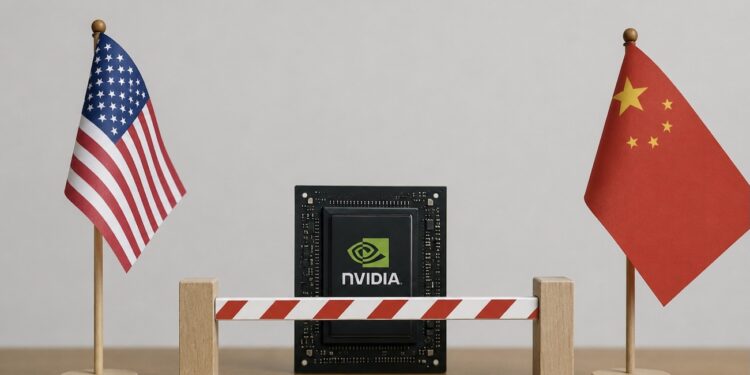
The latest US Commerce Department’s Bureau of Industry and Security (BIS) issued guidance saying export license requirements apply to advanced chips headed to entities headquartered in China even when those entities are located outside China. The step was designed to close a loophole that may have allowed subsidiaries in places such as Malaysia to obtain Nvidia’s most advanced Blackwell processors.
“The latest Commerce Department guidance denotes a shift from controlling where AI chips are shipped to scrutinizing who ultimately controls the companies receiving them, a sign that Washington is moving beyond geography and toward ownership-based enforcement in the global AI race.”
The policy expresses a familiar U.S. national-security concern: advanced AI chips are now treated as strategic hardware, not just commercial semiconductors. Washington has spent the past two years tightening controls on high-end computing exports to limit China’s ability to build and train frontier AI systems, and the new guidance shows that indirect access through overseas affiliates is now part of the enforcement target.
BIS said it would enforce existing license requirements that have been in place since 2023, rather than introducing a wholly new framework. The guidance does not change Nvidia’s position directly, because the company had already been told by Commerce that a license requirement applied to those shipments.
[Also Read: Jensen Huang Says Nvidia’s $200 Billion CPU Opportunity Includes China ]
The loophole at the center of the story
According to Reuters, the concern is that Chinese firms were able to route purchases through subsidiaries outside mainland China, weakening earlier controls. One chip-industry source with supply-chain knowledge estimated the volume may have reached the hundreds of thousands, although that figure was not official and should be treated as an estimate, not a confirmed government count. The new guidance does not require data centers to stop using the chips already in service.
How this compares with earlier policy
This move fits into a larger shift in U.S. chip policy. In January 2026, BIS revised its review policy for advanced semiconductors exported to China, including Nvidia’s H200, moving to case-by-case review if security requirements are met. In May 2025, BIS rescinded the Biden-era AI Diffusion Rule and said it would issue replacement controls later, while also warning industry about the risks of U.S. AI chips being used to train or infer Chinese AI models. The new guidance looks less like a separate policy and more like a cleanup step after that earlier rollback.
[Also Read: Inside NVIDIA Corporation’s Strategic Bet on Mira Murati’s AI Startup, Thinking Machines Lab ]
What it means
For Nvidia, this is a compliance and market-access issue more than the ban. The company still faces a market where high-end China sales are possible only under narrow and shifting rules. For Chinese buyers, especially firms that operate through overseas holding structures or regional subsidiaries, the easy workaround is getting harder to defend.
For the wider semiconductor supply chain, export-control scrutiny is moving from destination countries to ownership structures, routing patterns, and end users.
The U.S. is increasingly focused on who ultimately controls the company that receives it, how that company is structured, and whether the transaction creates indirect access to restricted AI hardware. That is a more complex enforcement model, and it will likely affect chip licensing, distributor checks, and customer screening across Asia and other major technology hubs.