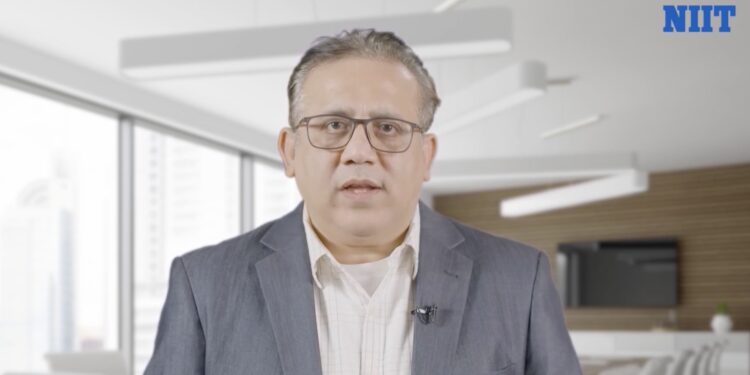
Technological change is accelerating at an unprecedented pace, and the intersection of AI and workforce development has become one of the most urgent and exciting frontiers. To understand how AI is reshaping the future of learning, skills, and work itself, CXOVoice conducts an interview with Sachin Grover, Head of GenAI Initiatives at NIIT Limited. Sachin shares his perspective on everything from the evolution of traditional education to the rise of AI-powered learning ecosystems, offering a firsthand look at how organizations and learners can thrive in the age of intelligent machines.
Q1. How is AI reshaping the global skills and workforce development landscape today?
AI is fundamentally changing how people acquire skills and how organizations develop talent. Earlier, traditional learning models were largely standardized, but with the emergence of AI, highly personalized and adaptive learning journeys are enabled which are tailored to individual roles, proficiency levels, and career goals.
Equally important is the pace at which skills are evolving. Professionals today must continuously reskill to stay relevant in an AI-driven economy. At NIIT, we are embedding GenAI across our learning ecosystem to help identify skill gaps in real time and recommend targeted learning pathways, enabling organizations to build future-ready workforces at scale. Our AI Horizon Model maps this progression across four stages: Literacy, Fluency, Proficiency, and Maturity, providing enterprises a structured roadmap to evolve workforce capability from basic AI awareness to strategic, organisation-wide AI adoption. The journey starts by establishing the current knowledge and skills through the AI Readiness Index (proprietary tool).
Q2. How should organisations rethink learning strategies in an era where skills become outdated quickly?
Organizations should aim to move from training programs to learning ecosystems. This is due to the fact that in a dynamic and constantly changing tech landscape, it is possible for skills to quickly become outdated, thus requiring dynamic and constantly changing learning strategies.
Currently, organizations are shifting their learning strategies from training in the workflow to using AI technologies that provide learning in the workflow. Modular learning strategies are increasingly being used due to their ability to help professionals develop their skills incrementally in a non-disruptive manner.
Q3. How can education institutes better align with industry skill requirements?
One way to bridge the skill gap is through increased academia-industry collaboration. Academic institutions will be required to adopt industry-driven curricula, project-based learning, and exposure to real-world problem-solving skills.
We at NIIT are working closely with businesses and global capability centers (GCCs) to develop role-based programs that not only provide knowledge but also provide skills that are industry-relevant. This way, when freshers are hired into the industry, they are equipped to meet industry requirements.
Q4. How can enterprises build intelligent reskilling programs at scale?
Organizations need to have structured reskilling strategies that are based on data and include technology and learning frameworks. AI can help organizations align the current skills of their workforce with the changing skills required for the roles. It can also help identify skill gaps at an early stage.
Additionally, organizations can leverage AI-based learning platforms to provide personalized learning experiences for thousands of employees at the same time. Initiatives such as enterprise skilling programs, carried out by NIIT and our subsidiaries, can help organizations build an in-house talent pool and facilitate an efficient transition for employees into new digital and AI-enabled roles. We structure these interventions using our AI Horizon Model, diagnosing where an organisation currently sits and designing a targeted learning path to move them forward systematically.
Q5. How can companies move from periodic training to continuous skill development?
The fundamental shift lies in incorporating learning into the daily process instead of considering it as a standalone event. Conventional training programs, conducted once or twice a year, are not sufficient in the fast-paced digital revolution.
AI-based learning tools can assist in suggesting appropriate training, tracking skill development, and offering micro-learning tools in real-time. At the same time, organizations need to build a culture that promotes and supports continuous learning, so that employees are able to adapt quickly to the changing landscape of technology and jobs.
Q6. How does Agentic AI differ from Generative AI in the context of learning and skilling?
Generative AI is primarily used for creating content such as text, code, or simulations. In terms of academic settings, this could be used to create personalized materials for studying, testing, and practice scenarios.
Agentic AI to Physical AI evolution is going to be the biggest trend setter in the future. This is where AI agents are able to plan, make decisions, and execute actions in order to achieve certain objectives in the real physical world. This will go way beyond, in terms of humanoids and robots. Even in academic settings, such future initiatives lead to intelligent systems that assist learners in complex problem scenarios or in simulating real-world environments in order to speed up the learning process. At NIIT, we are actively building agentic learning systems, AI that doesn’t just recommend content, but acts as a digital colleague guiding learners through complex, real-world challenges in the flow of work.
Q7. Are traditional degrees still relevant in the age of AI and rapid technological change?
While traditional degrees will continue to play an important role in building foundational knowledge, the way employers evaluate talent is clearly evolving. There is a growing emphasis on what individuals can do with their knowledge, not just the qualifications they hold. As a result, we are seeing a steady rise in competency-based learning models, micro-credentials, and stackable certifications.
Alongside this, there is a clear shift towards more hands-on, application-led learning. For example, programs like NIIT’s Building Agentic AI Systems are designed to immerse learners in real-world problem solving, giving them the opportunity to build and work with autonomous AI systems rather than just study the concepts. This kind of approach is becoming increasingly important, especially in fast-evolving areas like AI, where the ability to apply knowledge often matters more than theoretical understanding alone.
That said, mastery-based learning is not a replacement for traditional degrees. It is, instead, a powerful complement, one that enables professionals to continuously upskill and stay relevant in a rapidly changing landscape.
Q8. Do you see mastery-based learning replacing traditional certifications in the future?
Mastery-based learning will increasingly complement, and in many cases outperform, traditional certifications. Employers today value demonstrated capability over theoretical credentials. At NIIT, we’re already seeing strong traction for project-led, practitioner-designed programs that build real, job-ready proficiency.
Q9. Many students worry that AI may replace entry-level jobs. How should they prepare for the future?
AI will reshape entry-level roles, not eliminate them. The key is to move from task execution to problem-solving while combining domain knowledge with AI fluency. Learners should focus on working with AI tools, not competing against them.
Q10. What are the most important skills young professionals should focus on today?
A combination of digital skills (AI, data, cloud), strong problem-solving, and communication. The real differentiator is the ability to apply these skills in real-world contexts. This is something NIIT’s experiential learning models are designed to enable.
Q11. How can students build practical AI experience while still studying?
Students build practical AI experience by leveraging its applications first. By working on real-world projects, participating in hackathons, and using open-source tools and APIs. Programs that integrate hands-on labs and industry scenarios. There are certain GenAI-focused offerings we have here at NIIT, which help bridge the gap between theory and application.
Q12. What common mistakes do learners make when choosing courses or skills?
I won’t call these mistakes; there are certain decisions or assumptions any individual can make during their learning journeys. One could be focusing on trends rather than outcomes, and prioritizing certifications over capability. Learners should evaluate whether a program builds applied skills, includes hands-on work, and aligns with today’s industry needs.
Q13. Which AI and technology skills are currently most in demand across industries?
AI/ML fundamentals, prompt engineering, data analytics, cloud platforms, and skills around GenAI and agentic systems. The ability to integrate these into business workflows is becoming critical. It is highly important as an individual contributor or a team player how you’re benefiting your organisation today with the applications of AI, or transforming the overall ecosystem with the help of AI. In both cases, the aim should be to deliver higher efficiency, lower cost and improved accuracy in deliverables.
Q14. What role will human skills like creativity, critical thinking, and collaboration play in an AI-powered workplace?
When the mundane, repetitive tasks are being taken care of with automation, skills like creativity, critical thinking and collaboration become even more important. As AI handles routine tasks, human skills will drive decision-making, innovation, and context-setting. The future workforce will be defined by how effectively humans and AI collaborate. It is easy to get solutions from automated intelligence.
Q15. Looking ahead five years, how do you see AI transforming education and workforce development globally?
AI will make learning more personalized, continuous, and outcome-driven. We’ll see a shift toward modular, skills-based pathways and lifelong learning ecosystems. Institutions like NIIT are already evolving to deliver scalable, AI-integrated learning experiences aligned to industry needs. We intend to build AI-native learning ecosystem where every learner can initiate their journey from AI Literacy to full AI Maturity, and where the learning interface itself is powered by intelligent agents that adapt, guide, and grow with the learner.