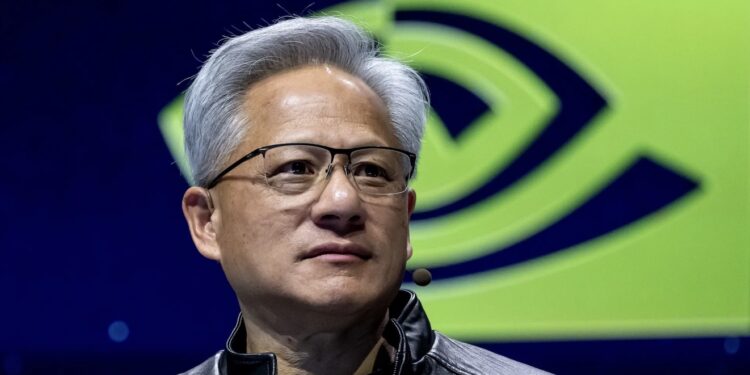
Nvidia’s latest growth story is no longer only about GPUs. In Taipei on May 23, 2026, CEO Jensen Huang said the company’s forecast for a $200 billion CPU market includes China. The company is reinforcing that Nvidia still sees the Chinese market as part of its long-term demand picture even as U.S.-China tech restrictions continue to tighten.
After Nvidia had already told investors that its new Vera CPU line opens access to a $200 billion market. On Nvidia’s earnings call earlier in the week, the company framed the CPU business as a new growth leg beyond its core GPU franchise. Jensen Huang’s follow-up in Taipei was the part that added China explicitly into that outlook.
At a press interaction in Taipei, with Jensen Huang speaking to reporters while he was in Taiwan ahead of Computex and meeting supply-chain partners, including TSMC. According to Reuters, he answered directly when asked whether the $200 billion CPU opportunity included China, replying that he would think so.
[Also Read: Inside NVIDIA Corporation’s Strategic Bet on Mira Murati’s AI Startup, Thinking Machines Lab ]
Why the China point matters
China is central to the story because Nvidia has faced repeated export-control pressure in advanced AI chips. The U.S. has cleared sales of Nvidia’s H200 chip to 10 Chinese firms, but no deliveries have yet gone through because Chinese approvals are still pending. That leaves Nvidia in a holding pattern on one of the world’s biggest technology markets.
Jensen Huang’s statement suggests Nvidia is thinking in two time frames at once. In the short term, China revenue is constrained by regulation and approval risk. In the longer term, Nvidia is still treating China as a meaningful buyer of AI infrastructure and CPU-based systems. That is the real message hidden inside the headline number.
The company’s strategy is also shifting technically; Nvidia has been known primarily for GPUs, but the Vera CPU line shows it is trying to own more of the AI compute stack, not just the accelerator layer. Reuters noted that broader agentic AI demand is helping expand the market beyond GPUs into CPUs and other infrastructure pieces. In other words, Nvidia is trying to sell the entire system, not one chip.
[Also Read: Amazon, Nvidia, and SoftBank Power OpenAI’s Historic $110 billion Capital Raise ]
That makes the China mention more than a geography note. It means Nvidia still sees Chinese demand as relevant to the next phase of AI infrastructure, even if political conditions keep the immediate business uncertain. Jensen Huang has warned Nvidia’s market share in China has fallen sharply because of restrictions and local competition, which makes the inclusion of China in a $200 billion forecast even more notable.