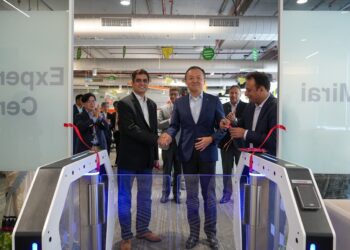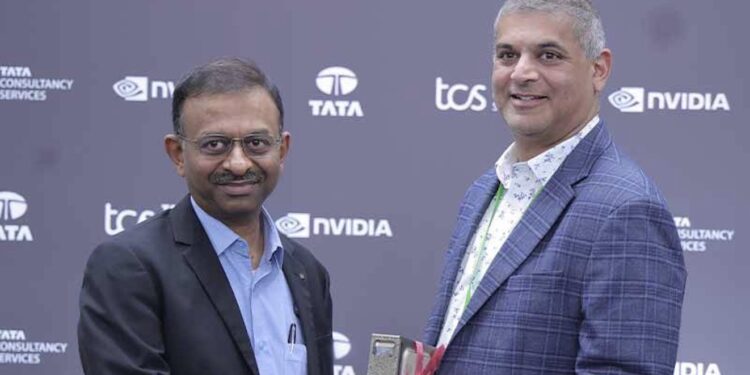
Tata Consultancy Services has launched the TCS Autonomous Engineering Lab Powered by NVIDIA at its Global Axis campus in Bengaluru. The company says the new facility is a physical AI hub to speed up the development and real-world deployment of AI-led mobility and industrial solutions using NVIDIA AI infrastructure.
According to TCS, the lab will enable customers to rapidly prototype and simulate use cases across mobility, manufacturing, and other industrial settings. Enterprises can use the facility to test solutions in a controlled environment before rollout, which is meant to reduce deployment risk and shorten time to market.
Sreenivasa Chakravarti, Global Head & Vice President of Industrial Autonomy and Engineering, TCS, said, “Bengaluru has long been the engine of India’s economy, and this lab harnesses that energy to reimagine what’s possible with AI. By combining NVIDIA’s powerful AI platform with TCS’ Industrial Autonomy & Engineering capabilities, we are creating a space where ideas move rapidly from concept to real-world impact, shaping the future of mobility and industrial systems. As we move forward into our next phase and deepen our collaboration, we will build on this momentum into scaled deployment and enterprise-wide transformation for more customers, with confidence and speed.”
[ALSO READ: TCS and AMD Forge Strategic Collaboration to Scale Enterprise AI Adoption ]
TCS also says the lab will support the broader engineering and manufacturing lifecycle by embedding intelligence into products, plants and operational systems. That means the lab is aimed at work where AI meets physical operations: vehicles, factories, industrial equipment and service systems.
TCS’s new lab includes five solution areas: TCS DriveSphere, AI-led mobility and autonomous systems solutions, physical AI and smart manufacturing use cases, agentic AI and vision AI solutions, and digital twin and simulation environments.
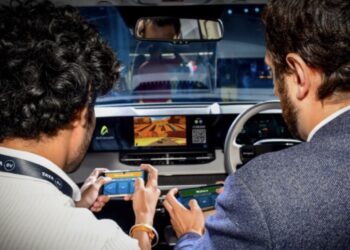
TCS DriveSphere is described as a connected, AI-led mobility platform that uses digital twins, real-time data ingestion, predictive analytics and over-the-air lifecycle management for software-defined vehicles. The other solution blocks focus on advanced driver assistance systems, autonomous driving, predictive maintenance, automated quality inspection, real-time process optimization and high-fidelity simulation.
The lab is built on NVIDIA AI infrastructure, and NVIDIA’s AI Consulting Partners team says enterprises need specialized infrastructure to move from simulation to real-world deployment. In NVIDIA’s view, the TCS lab gives customers a path to validate and implement industrial AI solutions on a full-stack AI platform.
TCS says the new lab extends a longstanding collaboration with NVIDIA across AI, accelerated computing and industry-specific solutions, moving the relationship beyond integration into deeper capability building and solution development.
What it means
Industrial AI is becoming harder to deploy through slide decks and proof-of-concept trials alone. Companies want a place where they can test how AI behaves inside vehicles, factories and operational systems before they commit to large-scale rollout. TCS is positioning this Bengaluru lab as that kind of environment.
The TCS new AI lab is aimed at operational AI, not just model experimentation. For manufacturing and mobility customers, that is the part that matters most.
Other TCS labs in Bengaluru
In August 2025, TCS opened a Google Cloud Gemini Experience Center at its BFSI Innovation Lab in Bengaluru, focused on financial services use cases and agentic AI for banking and customer operations.
A month later, TCS and Qualcomm announced a co-innovation lab in Bengaluru focused on Software Defined Everything and Edge AI. That lab was set up to support industrial, healthcare, smart infrastructure and security use cases, using Qualcomm platforms.
The Google Cloud lab is tied to BFSI, the Qualcomm lab is tied to edge AI and connected devices, and the new NVIDIA lab is centered on industrial autonomy, mobility and manufacturing. Bengaluru is becoming a layered innovation site for TCS, but each lab now has a narrower technical focus.
[ALSO READ: Google to Set Up AI Research Lab in Bangalore, India ]
Context: why Bengaluru keeps showing up
Bengaluru remains the most common location for this kind of enterprise AI work because it combines engineering talent, startup activity and large enterprise customer access.
The lab also shows how Bengaluru is now serving as a multi-lab hub for TCS, with separate facilities for BFSI, edge AI and industrial autonomy.