Nvidia said that a group of Japanese robotics and manufacturing companies is building on its physical AI stack to speed up development of intelligent machines across manufacturing, mobility, infrastructure and robotics. The effort centers on NVIDIA Cosmos, Isaac, Metropolis and Jetson platforms.
The announcement is not a single joint venture or one contract. It is a broad ecosystem move. Nvidia said Japanese physical AI leaders including AIRoA, FANUC, Fujitsu, Hitachi, Kawasaki Heavy Industries, Kubota, NEC, SoftBank Corp., Sony Group and Yaskawa Electric intend to join the NVIDIA Cosmos Coalition to help build open frontier physical AI models.
[ALSO READ: SoftBank Group has agreed to acquire ABB’s Robotics division for USD 5.4 billion ]
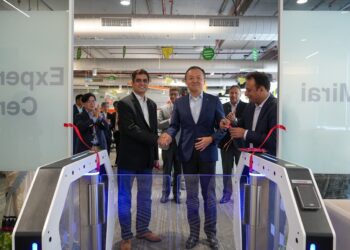
Reuters reported the Tokyo announcement and identified Fanuc and Yaskawa Electric as the companies Nvidia said it is partnering with to advance robotics and AI. According to Reuters, Jensen Huang appeared with executives from Fujitsu, FANUC, Yaskawa Electric and Kawasaki Heavy Industries at a media briefing in Tokyo.
Nvidia’s announcement points to a few specific technical layers. The company introduced Cosmos 3 Edge, a 4-billion-parameter model built on Nemotron that is designed to help robots and vision AI agents understand their surroundings, reason in real time and generate actions on edge computers. Nvidia said developers can adapt it for specific robots, vehicles, sensors and environments in about a day.
The Japan ecosystem is building on NVIDIA Isaac for robotics development, NVIDIA Metropolis for vision AI, Jetson for edge deployment, and the Newton physics engine for simulation-to-real workflows and pre-deployment validation. Nvidia said these tools are being used for digital twins, robot learning and simulation before systems are deployed in the real world.
Nvidia stated Enactic is fine-tuning the Isaac GR00T open model for elder-care semi-humanoid robots, GROOVE X is building Jetson-powered companion robots, and Telexistence is applying Isaac and exploring Cosmos for retail automation. It said TRON K.K. is developing manufacturing data workflows for assembly, picking, inspection and material handling, while Kubota is exploring Cosmos-based physical AI for autonomous agriculture and smart farming.
[ALSO READ: Tech Mahindra and Viam Partner to Scale Advanced Robotics and Automation Solutions ]
What it means
This is best read as an effort to move robotics development from isolated pilot projects toward a shared physical AI stack. Nvidia is trying to make its software and simulation tools the base layer for robot learning, validation and deployment. Nvidia’s pitch is that Cosmos, Isaac, Metropolis and Jetson can shorten that gap.
Fujitsu’s role in the announcement is to help build a collaborative control platform that integrates NVIDIA’s physical AI stack across industrial sectors. Nvidia said that the platform is intended to bridge digital and physical operations through model development, digital twins, robot learning, simulation-to-real workflows and pre-deployment validation.
A year earlier, Nvidia and Fujitsu had already said they were working together on AI infrastructure for Japan and that the work could include robots, manufacturing, healthcare and customer services by 2030. The new announcement moves that relationship deeper into robotics and physical AI.