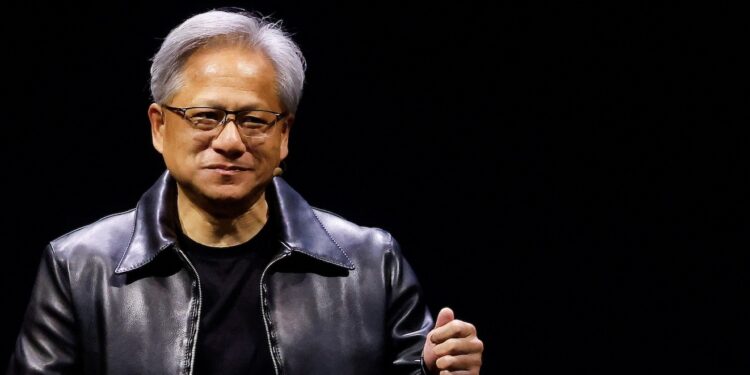
Nvidia chief executive officer Jensen Huang used a press conference in Taipei during Computex week to send a message to investors and customers: the company still faces supply constraints, but it now has enough capacity to support strong growth in both CPUs and GPUs as AI demand keeps rising.
Huang said Nvidia had “secured supply for strong growth” across those systems, while also adding, “We have supply for, very strong growth, but we’re still supply constrained.” The combination matters because it shows Nvidia is not claiming the bottleneck has disappeared. It is saying the company has enough room to keep growing even if demand remains ahead of supply.
The comments came one day after Nvidia unveiled a new chip aimed at bringing AI features straight to personal computers. The new chip will launch in the fall and will compete with products from AMD, Intel and Apple. Huang also said the RTX Spark PC chip is part of Nvidia’s effort with Microsoft to “reinvent the PC” for the AI era.
[Also Read: From Barcode to Intelligence: How Traceability Is Redefining Manufacturing in India ]
Nvidia is not only trying to keep up with demand in data centers. It is also pushing further into the PC market, where the company wants its chips to power the next wave of AI-enabled machines. If supply is tight, that expansion becomes harder. Huang’s point was that Nvidia thinks it has enough production capacity to keep the growth story intact.
Huang made the remarks at an Nvidia press conference during Computex week in Taipei, Taiwan. Nvidia’s Computex coverage shows that the company used the week to stage product announcements, partner events and a Taipei keynote for its GTC program. The Nvidia blog says GTC Taipei keynote coverage was tied to the company’s broader Computex presence and that Huang addressed the audience live from the Taipei Music Center.
That setting matters because Taiwan is central to Nvidia’s supply chain. Reuters noted that Huang described Taiwan as a strategic partner for the United States and said Nvidia intends to keep investing there and make the supply chain as resilient as possible. He also said Nvidia is now the largest purchaser in Taiwan’s ecosystem.
Supply constraints still exist, but Huang is signaling that they are no longer severe enough to block growth. Nvidia is an indicator of the AI market because its semiconductors are used in nearly every major data center, so any comment on supply is also a comment on the wider AI cycle.
[Also Read: US Moves to Stop Chinese Firms Accessing Nvidia Chips Through Overseas Units ]
He also said Nvidia’s Vera data center CPUs would become an important growth driver and described them as potentially even more popular than GPUs because CPUs are necessary for processing data. On Monday, he called Vera “our new major growth driver.” That suggests Nvidia is widening its revenue base beyond the GPU business that made it dominant in the first place.
For investors, the company still sees supply as tight, but not tight enough to stop growth. For the wider industry, the remarks reinforce how much AI hardware now depends on supply chains in Taiwan and on the continued balance between chip demand, manufacturing capacity and product rollout speed.
In simple terms, Huang is saying Nvidia is still under pressure, but it is not boxed in. The company expects strong AI demand to continue, and it believes it has enough supply lined up to keep pace with it.