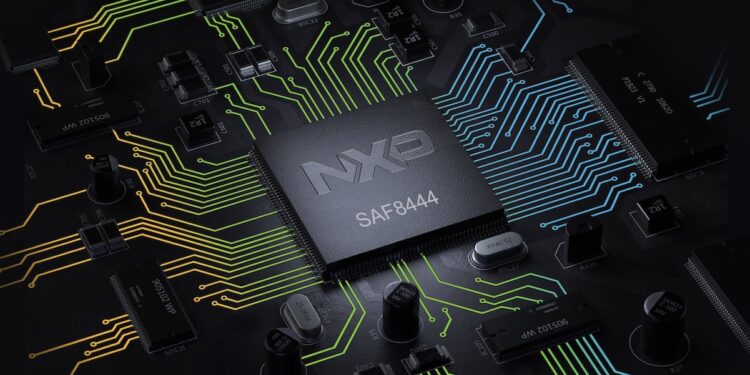
NXP Semiconductors has introduced the SAF8444, a new automotive radar system-on-chip (SoC) aimed at making advanced driver assistance systems cheaper, smaller and easier to deploy in mass-market vehicles. The chip is designed around NXP’s 28nm RFCMOS one-chip radar architecture and is positioned for next-generation front and corner radar systems, with a particular push toward electric vehicle platforms.
The SAF8444 is a radar SoC; it combines radar processing, embedded compute and signal acceleration in one device, with support for the 76–81 GHz automotive radar band and short-, medium- and long-range sensing. It is aimed at common ADAS functions such as adaptive cruise control, autonomous emergency braking, blind-spot detection and park assist.
“SAF8444 strengthens our one-chip radar portfolio with a solution that balances performance, power efficiency, and cost,” said Meindert van den Beld, Senior Vice President and General Manager, Radar & ADAS, NXP Semiconductors. “It allows customers to meet tightening safety requirements while reducing system cost, an essential step toward democratizing ADAS adoption.”
NXP says the chip integrates an Arm Cortex-A53 applications processor, an Arm Cortex-M7 real-time core, and NXP’s proprietary Single Processing Toolbox (SPT) radar accelerator with DSP support. It also includes a dual-threaded radar accelerator for interference mitigation and anti-jamming workloads.
[Also Read: NXP unveils S32N7 series to digitize and centralize core vehicle functions ]
Automakers are under pressure to add more driver-assistance features while keeping vehicle cost and power consumption under control. That is especially important in electric vehicles, where every watt used by sensors and compute can affect range, heat management and packaging.
NXP says the new RF design helps reduce overall system cost by simplifying thermal management and easing vehicle integration.
The other important point is regulatory. The release explicitly ties SAF8444 to the path toward Euro NCAP 2030 expectations, which are pushing safety systems to handle real-world cases such as obstructed pedestrians in low light and robust operation in poor weather. Those requirements are harder to meet with camera-only systems. Radar remains useful because it works in rain, fog, darkness and other low-visibility conditions.
The industry has spent the last few years moving from isolated safety sensors to more integrated perception systems. SAF8444 is built to support perception-level processing directly on the radar SoC, which can reduce the need for heavier centralized compute elsewhere in the car.
Centralized ADAS architectures often require more processing silicon, more cooling, more wiring, and higher overall bill of materials.
By shifting more work into the radar chip, NXP is trying to break that trade-off. The practical result is a radar platform that should be easier to scale across a wider range of vehicle price points, not just premium models
[Also Read: MediaTek and DENSO Forge Strategic Alliance to Drive Next-Gen Automotive ADAS Solutions ]
For automakers, SAF8444 could make it easier to offer radar-based ADAS features in cheaper vehicles without forcing major redesigns of the electrical and thermal architecture. For EV makers, the lower-power design is especially relevant because sensor efficiency now matters as much as raw sensing range.
Availability: The SAF8444 automotive radar one-chip SoC is announced today and is currently in pre-production, targeting next generation front and corner radar designs. Development support for lead customers is available now. For more information, visit nxp.com/saf8444.