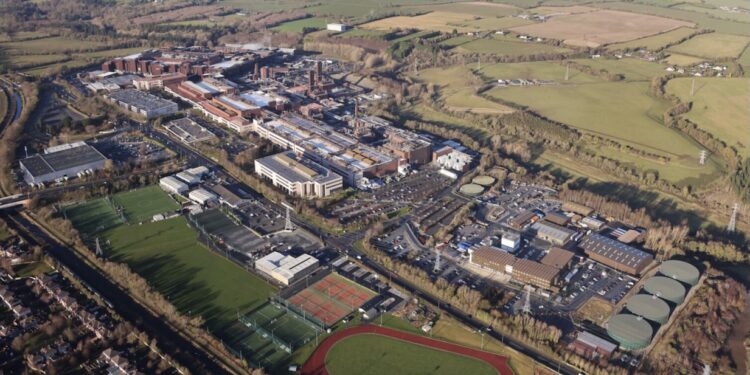
Intel announces a €5 billion ($5.7 billion) capital investment at its Leixlip campus in Ireland to expand manufacturing capacity, increase output for AI and computing chips, and advance research and development. The company said the project will upgrade existing fabrication facilities, add leading-edge equipment, and strengthen Europe’s semiconductor supply chain. ;
Naga Chandrasekaran, Executive Vice President, Chief Technology and Operations Officer and General Manager of Intel Foundry said, “This €5 billion investment represents a definitive commitment to maximize capacity at our Leixlip campus and increase what we can deliver to Intel Foundry customers.”
According to Intel, the Leixlip investment will focus on its existing manufacturing base. The work includes expanding the automated track system, connecting campus modules into a more integrated production environment, and using existing cleanroom space more efficiently. The site produces Intel 3 silicon wafers and will support Intel Xeon 6 and next-generation Xeon processors.
The investment had already started earlier in 2026, with the majority of the spending expected to be deployed by the end of 2027.” Intel described the Leixlip site as one of its most advanced manufacturing facilities in Europe.
[ALSO READ: Europe’s Grid Upgrade Accelerates with $200M Investment from ABB ]
Intel tied the investment directly to rising demand for AI and high-performance computing. As per Intel, the need for advanced silicon is rising because of AI factories and server demand, which is pushing Intel to increase capacity for Intel 3 wafers and server processors.
Intel’s project supports Ireland’s semiconductor ecosystem and contributes to the European Union’s technology-sovereignty goals by helping create a more resilient domestic supply of advanced processors.
According to Intel, it has invested more than €30 billion in Ireland since 1989 and currently employs 4,900 people at the Leixlip campus. The new investment is expected to add several hundred jobs, while also creating construction and specialist trades work during the buildout.
In 2022, Intel laid out an initial €33 billion European investment plan across six EU countries, including Ireland, Germany, Italy and France. That earlier plan included €17 billion in Germany and an expansion of the Irish factory.
TSMC has followed a similar path. In 2023, the Taiwanese chipmaker committed €3.5 billion to its first European plant in Germany, as part of an $11 billion project supported by public funding. In 2024 that construction of TSMC’s first European facility was on track to start in the fourth quarter of that year.
Europe is trying to reduce dependence on imported chips, and manufacturers are placing capacity closer to major industrial customers. Reuters said the European Chips Act is a €43 billion subsidy plan intended to double chipmaking capacity by 2030.
Microsoft said in 2025 that it would invest $400 million in Switzerland to expand and upgrade four data centres near Geneva and Zurich, citing demand for AI and cloud services.
That matters for Intel’s announcement because it shows the same underlying logic across the technology sector: companies are spending on physical infrastructure in Europe where AI, cloud, data residency and supply-chain security are becoming part of the business case.
Intel said its investment supports Ireland’s semiconductor ecosystem, while Ireland’s prime minister and IDA Ireland both framed the project as evidence of confidence in the country’s skilled workforce and stable business environment.
[ALSO READ: TCS launches SovereignSecure Cloud in Europe ]
For businesses across Europe, more local chip capacity can help reduce exposure to global supply bottlenecks, especially for sectors that depend on server CPUs, industrial systems and AI infrastructure. Intel specifically said the Leixlip site will help strengthen Europe’s semiconductor supply chain.