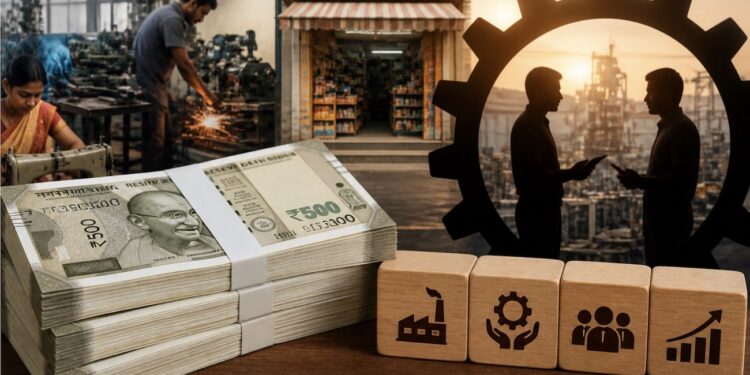
India’s Union Cabinet has approved ECLGS 5.0, a government-backed emergency credit guarantee scheme with a fiscal outlay of ₹18,100 crore and a target of ₹2.55 lakh crore in additional credit flow, including ₹5,000 crore for airlines.
The credit guarantee scheme is meant to help MSMEs, non-MSMEs, and airlines deal with short-term liquidity stress linked to the West Asia situation.
Under this credit guarantee scheme, the government is not lending money directly to businesses. It guarantees loans so that banks and other lending institutions can extend more credit with lower risk. The official Cabinet says the scheme provides 100% credit guarantee for MSMEs and 90% coverage for non-MSMEs and airlines through the National Credit Guarantee Trustee Company Limited (NCGTC). The goal is to support businesses affected by the Middle East crisis.
[ Related Reads: Government plans ₹2.5 Lakh Crore Credit Guarantee Scheme to Aid War-Hit Businesses ]
Who can avail it
The eligible borrowers include MSMEs and non-MSMEs with existing working capital limits, as well as scheduled passenger airlines, provided their accounts are standard as of March 31, 2026. The scheme allows additional credit support to help borrowers bridge temporary cash-flow gaps.
Loan size, tenure, and repayment conditions
The eligible borrowers can access credit of up to 20% of peak working capital from Q4 FY2026, with a cap of ₹100 crore per borrower for general businesses.
Airlines can access up to ₹1,500 crore per borrower. The loans carry a five-year term with a one-year moratorium for businesses, and a seven-year term with a two-year moratorium for airlines.
The scheme is open for sanctions until March 31, 2027.
The ₹2.55 lakh crore is a high-leverage intervention: a relatively small fiscal commitment is being used to unlock a much larger amount of bank lending.
[Also Read: State Bank of India Introduces USD 500 Million Social Loan Initiative for Women ]
What it means for MSMEs
For small businesses, it is a working capital relief. When companies’ orders are delayed, import costs rise, supply chains get tight, or receivables take longer to come in. In that situation, access to guaranteed credit can keep payroll, inventory, and vendor payments moving. The scheme is aimed primarily at small and medium enterprises facing liquidity challenges.
The government is treating the West Asia shock as a liquidity and supply-chain problem, not just a trade issue.
Sectors such as textiles and glass manufacturing have already faced disruption, while higher oil exposure remains a wider risk for inflation and business costs. By backing bank lending, the Cabinet is trying to prevent temporary stress from turning into layoffs, payment defaults, or production cuts.
The first emergency-style design has now been adapted to a geopolitical and supply-chain shock. That makes the policy less about stimulus and more about keeping credit channels open when private lenders may hesitate.
[ Also Read: Budget 2025 Brings Big Reforms for MSMEs Sector ]
India’s approval of the ₹18,100 crore credit support scheme is best read as a liquidity shield for MSMEs and related businesses. It is not a grant program, and it is not a broad demand boost. It is a targeted guarantee mechanism meant to keep credit flowing when external pressure is raising financing risk. For businesses under strain, that distinction matters more than the headline number.