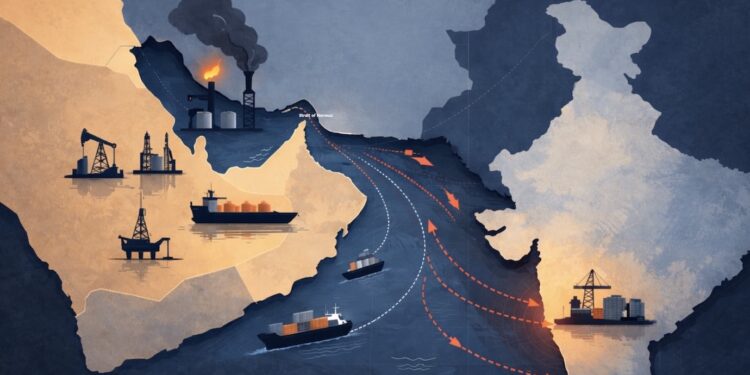
March 2, 2026: The Strait of Hormuz, a two-mile-wide maritime corridor off the coast of the Arabian Peninsula, sits at the centre of an acute risk calculus for India. In the current escalation involving the United States, Israel and Iran, threats by Tehran to interdict navigation have moved from rhetorical leverage to an immediate operational hazard for seaborne energy flows, and for India’s economy. The following analysis, grounded in verified data and contemporaneous reporting, examines how and why the strait matters to India, what the present hostilities change, and what practical exposures Indian industry and policy must weigh.
Short-duration disruptions are likely to be disruptive; long-duration closures would force economically painful adjustments.
1) What actually transits the Strait of Hormuz
The Strait of Hormuz is one of the most important routes for India and global trade. Energy-agency tallies show the scale plainly. About 20 million barrels per day of crude and product flows, a figure commonly cited by the IEA and corroborated by the U.S. Energy Information Administration, move past the Strait of Hormuz on a typical year, representing roughly a fifth (and, by some measures of seaborne trade, a larger share) of global petroleum liquids trade. The IEA further notes that a large majority of those flows are destined for Asian markets. This concentration means the Strait of Hormuz is not a marginal route: it is a primary artery for the commodities that power India’s industry, transport and power sectors.
Mechanically, most export cargoes transit the narrow shipping lanes on either side of the central islands. Alternative routes (bypass pipelines, routes around Africa) exist only at limited capacity and with significant cost and time penalties; the IEA’s fact sheet quantifies spare pipeline capacity and shows it cannot fully substitute the maritime throughput in the near term.
2) India’s dependency profile (what India gets, and where)
India is the world’s third-largest oil consumer and importer, and its crude sourcing has been geographically diversified over the past decade, with substantial purchases from the Gulf states and Africa. Nevertheless, Middle Eastern producers (Iraq, Saudi Arabia, UAE, Kuwait, etc.) together supply a very large share of India’s crude on a rolling basis; Reuters reporting places the Middle East’s share of India’s monthly imports near or above 45–50% in recent periods, with OPEC producers’ share rising again in 2024 as Russian flows became more variable. In operational terms, this means that any Persian Gulf interruption reverberates through India’s refinery intake schedules and import bills. According to Kpler tracking data in early 2026, India’s share of that throughput stands at roughly 2.5–2.7 mb/d, which is approximately 50 % of its total crude oil imports, sourced from Iraq, Saudi Arabia, UAE and Kuwait via the Strait of Hormuz.
India’s dependence is not only about crude barrels. Liquefied natural gas (LNG) shipments, used for power and industry, also route via or near the strait when exported from major Gulf producers, notably Qatar; disruptions to LNG shipping paths would therefore add a second energy vector of risk. The IEA estimates that all of Qatar’s (and much of the UAE’s) LNG destined for overseas markets traverses these waters.
3) Immediate effects seen in the current escalation
As the US-Israel strikes on Iranian targets have intensified, market and shipping behaviour have already shifted in measurable ways. Vessel-tracking data and commercial reporting show hundreds of tankers diverting, anchoring off Gulf ports, or suspending transit through the Strait of Hormuz out of safety concerns; insurers and operators have paused routine passage, and LNG carriers in particular have altered courses. Those operational frictions, even short of a formal closure, increase voyage time, freight charges and war-risk premiums. Reuters’ recent coverage of ship anchoring and shipment suspensions captures this precise dynamic: traders react to perceived risk faster than the underlying physical disruption.
Iran’s repeated public threats to “close” the Strait of Hormuz and reports that it has prepared sea mines or other interdiction tools are critical because they raise the probability that disruptions will become kinetic rather than merely precautionary. Past episodes (e.g., mining threats, seizures of tankers) show that the mere risk of mines or seizures tends to cause voluntary suspension of transits by commercial operators, producing de facto chokepoint friction even if international navies maintain passage. Reuters reporting documenting Iranian preparations to mine the strait underscores that these are not sterile rhetorical threats.
4) Transmission channels to the Indian economy
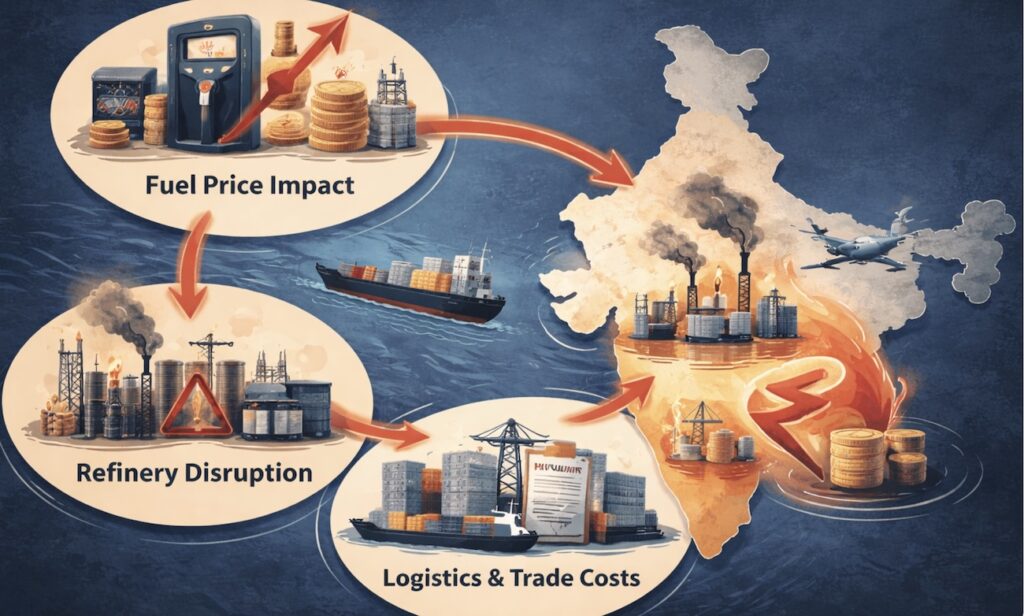
If flows through the Strait of Hormuz are impaired, the transmission to India would occur through three immediate channels:
• Fuel price channel. India imports most of its petroleum products and crude feedstock. A reduced global supply or risk premium on oil increases domestic pump prices (in India, administered taxes mute but do not eliminate pass-through), raises input costs for transport and industry, and feeds general inflation.
• Refinery and feedstock channel. India’s refinery operations are configured for specific crude grades. Disruption forces spot purchases at higher freight and risk premia, or temporary refinery reconfigurations that reduce throughput and product yields.
• Logistics and trade channel. Higher freight costs, longer voyage times, and surging marine insurance premiums increase landed cost on many traded inputs and exports, squeezing margins for manufacturing and retail sectors.
All three channels compress corporate margins, worsen the balance of payments, and complicate monetary policy choices, especially if elevated energy costs coincide with currency pressures. These mechanisms are well established in economic literature and borne out in historical price responses to earlier Gulf crises. (See citations in sections above for contemporary evidence.)
5) Sectoral consequences and near-term vulnerabilities
The most exposed Indian sectors are predictable: petrochemicals and fertiliser (feedstock-linked), aviation (fuel cost-intensive), logistics and shipping, and heavy industry such as steel and cement. Consumer-facing sectors would feel indirect effects through inflation: food and household goods prices typically rise when transport and energy costs increase.
Two additional points merit emphasis. First, India’s public finances are materially affected: higher oil import bills expand the current account deficit, and any sustained spike could force policy tightening or draw down reserves. Second, the short-term coping tools (strategic petroleum reserves, redirection of shipments, temporary subsidy adjustments) have limited scope: they buy time but do not eliminate structural vulnerability while the Strait of Hormuz remains the principal conduit.
6) Probability assessment and what to watch next
A rational probability assessment must separate temporary disruption (days to weeks) from sustained closure (weeks to months). Historical precedent suggests that sustained, complete closure is low-probability because it would inflict heavy cost on Iran itself and on global markets; but medium-probability outcomes (mines, seizures, intermittent interdictions, insurance-driven rerouting) are very much in play under heavy military escalation. Market and shipping indicators to monitor in real time include: tanker movements and anchoring patterns, war-risk insurance rate changes, LNG carrier routing, spot Brent volatility, and official communications from naval task forces in the region. Recent tracking data showing hundreds of ships anchoring is an early-warning indicator that operators are already pricing elevated risk into logistics decisions.
Final assessment
For India, the Strait of Hormuz is both a present operational headache and a strategic constraint. In the near term, firms should prioritise hedging, operational contingency, and cash/liquidity buffers; policymakers should calibrate releases from strategic reserves and engage in coalition diplomacy to keep shipping lanes open. Over the medium term, India should accelerate structural diversification of energy supply and increase the speed and scale of resilience investments, but these measures will not nullify the short-term pain of an acute Gulf interruption.
For India’s industry and finance leaders, the prudent approach is to treat Hormuz-related risk as an active component of enterprise risk management rather than a distant geopolitical story. The costs of preparedness are measurable and finite; the costs of being unprepared are not.
Also Read: Ant International launched its First Middle East Office in Riyadh, Saudi Arabia