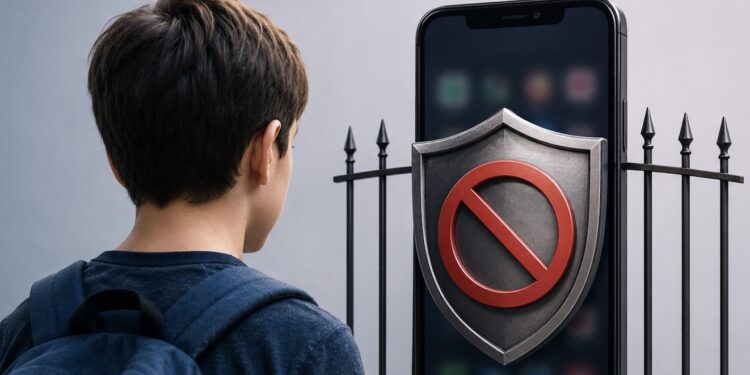
Britain has moved to one of the toughest child social media rules in the world. As per the government’s plan, major social platforms would be blocked for users under 16, with enforcement expected to begin in Spring 2027. Britain’s social media ban policy is framed by ministers as a child-safety measure, but it has also reopened a wider debate about privacy, enforcement, and whether access bans solve the core problem.
Britain’s social media ban targets platforms such as TikTok, Instagram, Snapchat, YouTube, Facebook, and X, while messaging apps like WhatsApp and Signal are not intended to be included. Officials say the plan is designed to limit children’s exposure to harmful content, pressure from algorithms, and contact with strangers online. The policy follows a consultation that drew 116,211 responses and sits alongside the wider Online Safety Act framework.
Why Britain wants tougher restrictions
According to the UK government, social media has become too influential in children’s daily lives and that existing safety tools have not been enough. Ministers point to bullying, abuse, addictive design features, and concerns about children being drawn into harmful online spaces.
Prime Minister Keir Starmer said the country is aiming to restore childhood by limiting digital exposure, while the government has said the move is backed by 9 in 10 parents in consultation data.
UK is going further than Australia, because it is not only targeting social media access but also gaming and livestreaming services, with possible curbs on infinite scrolling and overnight use for under-18s. That makes the British proposal broader than a simple age gate.
What the ban would mean
Britain’s social media ban policy would push platforms to verify age more aggressively and stop under 16s from creating or keeping accounts. The enforcement approach is platform-level, not a punishment model aimed at children themselves.
The announcement said the ban would apply to services built around user-to-user interaction and algorithmic content delivery. It also said the wider package could include restrictions on livestreaming and on strangers contacting children through gaming platforms.
[ALSO READ: Meta, YouTube Held Responsible in Social Media Addiction Ruling ]
The mental health argument
Supporters of Britain’s social media ban say the policy responds to long-running concerns about youth mental health, screen time, cyberbullying, and exposure to harmful content.
If a platform creates risk and children are especially vulnerable, then limiting access appears to be the cleanest response. That argument has gained force as more parents say they feel outmatched by platform design and recommendation systems.
That tension is central to the whole discussion: the same platforms can be a source of harm for some young people and a source of support, learning, and community for others.
The key question: is social media the problem?
Social media is not one thing; for some teenagers, it can mean pressure, comparison, and exposure to harmful content. For others, it is where they find information, peer support, or communities they do not have offline. Critics of blanket restrictions argue that a total age ban treats all usage as equally risky, which is not how young people actually experience these services.
[ALSO READ: How Meta and YouTube Harmed Young Users, According to Landmark Court Ruling ]
That is why some child-safety groups and digital-rights critics have argued for stronger design rules rather than a pure access ban. The debate is no longer only about whether children should be there; it is also about what those platforms are built to do.
Privacy concerns could become the biggest obstacle
Age verification is the point where this policy could run into its hardest practical and civil-liberties questions. To keep under-16s out, platforms need to know who is under 16. That raises obvious questions about identity checks, data storage, facial age estimation, and what happens to the personal information collected during verification.
Supporters respond that modern age-assurance tools can reduce the amount of personal data collected. The unresolved issue is whether the privacy cost of enforcement will be proportionate to the benefits the ban can actually deliver.
Can the ban actually be enforced?
Enforcement is another open question; teenagers are adaptable online users, and workarounds such as VPNs, shared accounts, and alternative services are already part of the public discussion. Reuters reported that the government intends to focus on the platforms rather than punish minors who try to get around the rules, but that still leaves the question of how effective the controls will be in practice.
The platform design debate
A major criticism is that the policy focuses on who can enter the platform, rather than how the platform behaves once a user is inside. Many of the harms parents and policymakers worry about are tied to features such as infinite scrolling, autoplay, algorithmic recommendations, notifications, and frictionless sharing. If those features remain unchanged, some critics argue, the ban only shifts the problem to older teens and adults.
Access control is politically simpler to explain, while product design is more complex due to the need for ongoing regulation, technical standards, and direct pressure on platform business models. The British government is opting for the quicker and more visible approach first.
Could children move to less safe platforms?
There is also the possibility of displacement. If major mainstream platforms are restricted, some young users may move to smaller services with weaker moderation, fewer safety tools, and less public scrutiny. Reuters noted that tech companies have argued bans could push teens toward less safe, more unregulated spaces. That is one of the most serious unintended-consequence arguments in the debate.
Prime Minister Keir Starmer defended the move as a necessary child-protection measure and said the government is acting to give children more childhood and less harmful scrolling. The government’s announcement itself framed the decision as a major safety intervention backed by parents. Ofcom, which will help shape enforcement, issued a statement welcoming the government’s announcement and pointed to its role in online-safety regulation.
The White House expressed its disagreement, urging the UK not to impose a ban on users under 16. They cautioned against implementing “one-size-fits-all” restrictions and using blunt regulatory measures. Additionally, Reuters reported that major tech companies, including Meta, YouTube, and Snapchat, pushed back against the idea, arguing that blanket bans could push teenagers toward less safe and unregulated platforms.
[ALSO READ: The Loneliness Epidemic in Urban Areas: A Mental Health Perspective ]