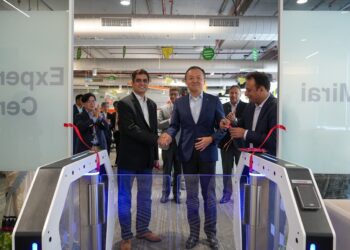
AMD and Samsung Electronics have signed a memorandum of understanding to expand their collaboration on next-generation AI memory and computing technologies. The signing ceremony was held at Samsung’s most advanced chip manufacturing complex in Pyeongtaek, Korea, attended by Dr. Lisa Su, Chair and CEO of AMD, and Young Hyun Jun, Vice Chairman & CEO of Samsung Electronics.
“Samsung and AMD share a commitment to advancing AI computing, and this agreement reflects the growing scope of our collaboration,” said Young Hyun Jun, Vice Chairman & CEO of Samsung Electronics. “From industry-leading HBM4 and next-generation memory architectures to cutting-edge foundry and advanced packaging, Samsung is uniquely positioned to deliver unrivaled turnkey capabilities that support AMD’s evolving AI roadmap.”
“Powering the next generation of AI infrastructure requires deep collaboration across the industry,” said Dr. Lisa Su, Chair and CEO of AMD. “We are thrilled to expand our work with Samsung, bringing together their leadership in advanced memory with our Instinct GPUs, EPYC CPUs and rack-scale platforms. Integration across the full computing stack, from silicon to system to rack, is essential to accelerating AI innovation that translates into real-world impact at scale.”
As per the agreement, Samsung and AMD will align on primary HBM4 supply for AMD’s next AI accelerator, the Instinct MI455X GPU, and on advanced DRAM solutions for AMD’s sixth-generation EPYC processors, codenamed “Venice.” The companies said these components will support AI systems built around AMD Instinct GPUs, EPYC CPUs, and rack-scale designs such as the Helios platform.
The partnership is not just about one chip or one product line, it points to a broader engineering shift in AI hardware, where memory has become as strategically important as compute. In simple terms, faster models and larger workloads are forcing vendors to optimise the full stack, from silicon to system to rack. That is the direction both companies described in their remarks.
Samsung also used the announcement to highlight its HBM4 platform, which it said is entering mass production and is built on its 6th-generation 10-nanometer-class DRAM process and a 4nm logic base die. The company said the memory can reach speeds of up to 13 Gbps and bandwidth of up to 3.3 TB/s. AMD said it expects Samsung’s HBM4 to support high-performance training and inference workloads on the MI455X.
Another part of the agreement focuses on DDR5 memory for the sixth-generation EPYC processors. AMD and Samsung said they will work together on high-performance DDR5 solutions tuned for systems based on the Helios rack-scale architecture. The release also said the companies will discuss possible foundry cooperation, with Samsung potentially providing foundry services for future AMD products.
Samsung said it has worked with AMD for nearly two decades across graphics, mobile, and computing, and that it has served as AMD’s primary HBM3E partner for the latest Instinct MI350X and MI355X AI accelerators. That history matters because it shows this is an extension of an existing supply-chain and engineering relationship, not a first-time alliance.
For the AI hardware market, the significance is fairly clear, the race is no longer only about GPU performance. It is increasingly about who can deliver the memory, packaging, and platform design needed to keep those GPUs fed with data efficiently. This announcement suggests AMD and Samsung are positioning themselves around that exact bottleneck.