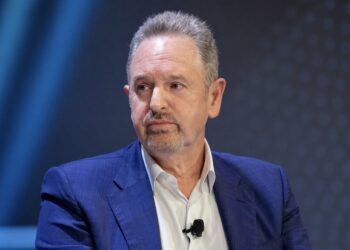
Vishal Garg, the founder of digital mortgage company Better.com, who became internationally known after he fired 900 employees on a video conference in December 2021. Now he has lost his position as chief executive officer (CEO) of Better Home & Finance Holding Company.
The leadership change occurs as the publicly traded mortgage lender continues a push toward an AI-based operating model while dealing with losses, cost reductions and a growing dispute over corporate control.
Garg accused Daniel Lewis, his successor as CEO, of misleading him about his intentions before taking over.
Vishal Garg, in an interview with CNN, said Lewis earned the board’s trust by publicly backing the company’s strategy, then used that trust to secure the CEO role. He hoodwinked me,” Garg told CNN.
“He said he supported our strategy, praised us publicly, and used that to join the board and gain our confidence. Lewis was named interim CEO on August 3, only a week after joining the board.
The initial announcement said the company and the board “mutually agreed” on the leadership change. Later, the company said the board, excluding Vishal Garg, voted unanimously to terminate him, citing concerns about his “judgment, temperament, and credibility.”
After the news, Better’s shares fell sharply, with reports citing a decline of about 36% during trading on August 4.
[ALSO READ: Meet Michael Truell, the 25-Year-Old CEO Whose Company Was Acquired by SpaceX for $60 Billion ]
Vishal Garg wasn’t just Better’s CEO. He founded the company and remained the public face of its strategy for years.
In May 2026, Better reported first-quarter revenue of about $48 million, up 52% from a year earlier, while loan volume increased 89% to approximately $1.64 billion. At the same time, the company reported a $70 million GAAP net loss, compared with a $51 million loss in the first quarter of 2025.
Better has spent the past two years attempting to change the economics of mortgage lending through automation and artificial intelligence. Its Tinman platform has become central to that strategy, while its Betsy AI loan assistant is designed to handle routine interactions with borrowers.
By the first quarter of 2026, Better said Tinman-generated volume represented about half of its total loan volume. Platform loan volume reached $821 million, a 404% increase from the same period a year earlier.
Better’s AI voice automation had moved routine customer communications away from manual workflows. A Better case study published with ElevenLabs said the Betsy system handled 1.89 million calls in 2025 and was associated with a 41% decrease in average cost to originate.
These figures are important because they show what Vishal Garg had been trying to build before leaving the CEO position: a mortgage company where technology does considerably more of the work that traditionally required loan officers, customer-service staff and other operational employees.
There is no reliable evidence, however, that the AI strategy itself caused Vishal Garg’s removal. The two developments should be treated separately.
From a $7.7 billion valuation to a difficult turnaround
Vishal Garg’s rise was closely tied to the housing boom during the pandemic.
Better attracted major investors, including SoftBank, and was once valued at roughly $7.7 billion in a proposed public-market transaction. Reuters reported in 2021 that Better planned to go public through a merger with Aurora Acquisition Corp. at that valuation.
The mortgage market subsequently changed dramatically.
Higher interest rates reduced refinancing activity, and Better’s loan volumes declined sharply. HousingWire reported that the company’s funded loan volume fell from about $57 billion in 2021 to $11 billion in 2022 and declined further as mortgage rates rose.
Better eventually completed its SPAC merger and began trading publicly in August 2023. The company continued to face financial pressure, while Vishal Garg increasingly emphasised technology, automation and cost control as a way to rebuild the business.
The contrast between the company’s earlier valuation and its later financial performance became one among the defining features of the Better story.
[ALSO READ: Former Meta Employees Say AI Unfairly Targeted Them for Layoffs; US Judge Declines to Halt Job Cuts ]
The 900-employee Zoom firing
Vishal Garg’s reputation changed dramatically on December 1, 2021. About 900 Better employees joined an online meeting expecting a company communication. Instead, Vishal Garg informed them that their employment was being terminated immediately. The layoffs affected about 9% of Better’s workforce, and Vishal Garg cited market conditions, performance and productivity.
The manner of the announcement became the story.
A recording of the three-minute call spread rapidly online, turning Vishal Garg into one of the most recognisable faces of the pandemic-era technology layoff wave. Vishal Garg subsequently apologised for how the layoffs were communicated, saying he had mishandled the execution. Better’s board then placed him on leave and said it would conduct an outside assessment of leadership and company culture.
The layoffs did not stop with the 900 employees
Better’s workforce reduction continued as the mortgage market deteriorated.
In March 2022, the company was reported to be planning another round of layoffs affecting roughly 3,000 employees in the United States and India. At the time, Better had more than 8,000 employees, including more than 2,000 in India.
HousingWire subsequently reported that Better had eliminated about 4,000 positions since December 2021 and later introduced a voluntary separation programme.
Vishal Garg’s second act: an AI-native mortgage company
By 2025 and 2026, Better was presenting itself less as a traditional digital mortgage lender and more as an AI-native financial platform.
Its Tinman system was increasingly being offered not only to Better’s own customers but also through partnerships with other lenders and financial platforms.
In the first quarter of 2026, Better said half of its loan volume came through the Tinman platform. The company also said its partnership with NEO Home Loans had helped increase NEO’s run-rate from $1.5 billion when the relationship began to $2.97 billion in March 2026.
A founder can build the strategy and still lose control of its execution
The Vishal Garg case also illustrates an old principle of corporate governance that becomes especially important when a startup becomes a public company.
Founders often have exceptional control during the early stages of a business. Investors back the founder’s vision, employees work directly around that person, and the board may give the founder considerable latitude.
Once a company is listed, the board’s responsibility is not simply to protect the founder. Directors are expected to oversee management, corporate reporting, financial controls and the long-term interests of shareholders.
Better became a public company in 2023, turning Vishal Garg’s relationship with the board into a different kind of relationship from the one he had during Better’s venture-backed years.