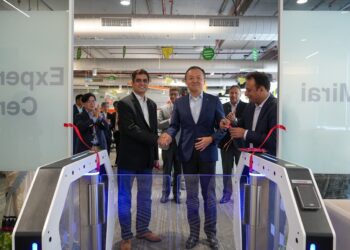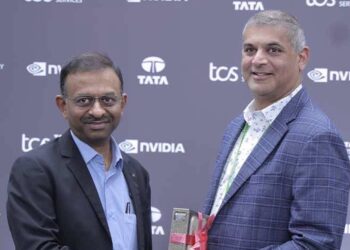
Tata Consultancy Services (TCS) has become the first global systems integrator partner for Mistral Forge. Companies are now looking beyond demos and pilots toward systems they can train, evaluate, govern, and deploy inside their own environments. TCS announced the partnership with Mistral, Mistral introduced Forge on March 17, 2026, as a system for building frontier-grade AI models grounded in proprietary enterprise knowledge.
Arthur Mensch, Chief Executive Officer and Co-Founder at Mistral, said, “TCS’ global scale and contextual industry knowledge make them an ideal partner for Mistral. Together, we are enabling enterprises worldwide to move from experimentation to AI deployment with systems that are open, production-ready and aligned with their strategic and operational requirements.”
This partnership sits at the intersection of three current enterprise concerns: control over data, industry-specific model behavior, and the difficulty of getting AI into production without losing governance. Mistral’s material says Forge is designed to turn internal knowledge into custom models without “infrastructure burden” or “cloud lock-in,” and its AI Studio material says most enterprise AI teams are still struggling to move from prototype to production with reproducibility, evaluation, and compliance in place.
TCS said the partnership makes it the first global systems integrator to bring Mistral Forge to enterprises worldwide. According to the company, the collaboration will let TCS build custom AI models for enterprise clients and use their data and business setting to enhance decision-making, while also tailoring delivery to industry needs, operations, and regulatory requirements across North America, the UK, Europe, and Asia-Pacific.
According to Mistral, Forge is an enterprise system for training models on institutional knowledge. Its product materials say the platform enables structured customization pipelines, end-to-end training from pre-training through reinforcement learning, production-grade evaluation, flexible deployment, and security controls including data isolation and auditable customization workflows.
Enterprise AI adoption has moved past experimentation, but production is where many projects stall. Mistral’s AI Studio release says teams are often blocked by the inability to reproduce results, track regressions, monitor real usage, run evaluations tied to their own benchmarks, and deploy governed workflows that satisfy security and privacy policies. That is the gap TCS is trying to fill with an implementation layer around Forge.
The old model was mostly about cloud migration, application modernization, and integration work. The newer model is about helping enterprises build and manage their own AI assets, including domain-tuned models, feedback loops, and governed deployment paths. TCS is effectively placing itself closer to the model-building side of enterprise AI rather than only the deployment side. This is an inference from the release and Mistral’s platform description.
K Krithivasan, Chief Executive Officer & Managing Director at TCS said, “The partnership with Mistral reinforces TCS’ commitment to scaling enterprise AI with trust, control, and measurable business outcomes at the core. This partnership expands TCS’ AI ecosystem, uniquely positioning TCS to create a differentiated solution proposition for our clients. Together with Mistral, we will solve for specific industry challenges, regulatory requirements, and sovereign needs for our enterprise customers.”
What Mistral Forge Is Built For
Mistral’s Forge release makes clear that this is not a general-purpose chatbot platform. The company says Forge is intended for enterprises that need models developed with internal documentation, codebases, structured data, and operational records. It stresses domain alignment, end-to-end training, production-grade evaluation, infrastructure flexibility, and governance. In practical terms, Forge is aimed at organizations that want AI systems to understand how their own business works, not just how language works.
That is an important distinction. A standard foundation model can answer broad questions well, but enterprise users often need models that reflect internal terminology, policies, workflows, and compliance rules. Mistral says Forge is intended to bridge that gap by grounding models in proprietary knowledge. That makes the platform more relevant for regulated industries, operational teams, and companies with large internal knowledge bases.
What Makes This Different From Generic Enterprise AI Deals
There is a difference between reselling AI tools and helping clients build models that reflect their own data. TCS says this collaboration is going to use Mistral Forge to build custom AI models for enterprises and deploy them with attention to industry, operational, and regulatory requirements. That is more specific than a standard “AI partnership” announcement, and it places the emphasis on model customization rather than only on application rollout.
Impact on Enterprise AI Adoption
The main effect of the partnership may be on how enterprises structure their AI programs, not only building one-off pilots; they can use an integrator like TCS to manage data preparation, model alignment, evaluation, and rollout together. That should be especially relevant for businesses that have already discovered that proof-of-concept work is easier than production AI. This is an inference drawn from Mistral’s own description of the production gap and TCS’s stated role in the collaboration.
The partnership shows a larger market trend toward more controlled AI deployments. Enterprises increasingly want systems that can be audited, versioned, and adapted to internal rules. Mistral’s Forge materials emphasize auditable customization workflows and data isolation, which are the kinds of features buyers ask for when AI is being used inside finance, manufacturing, public sector, or other regulated environments.
Global Context
Compared relative to the broader AI market, the TCS-Mistral deal sits in the segment where enterprise software, systems integration, and model training overlap. Mistral says Forge is already meant for enterprise use cases, and its company materials also list financial services, public sector and government, and manufacturing among its industry focus areas.
Some vendors sell packaged AI apps; others sell model access through APIs; others provide infrastructure. This cooperation is about connecting all three layers: the model, the enterprise data, and the delivery work needed to make the model usable in a real business setting.