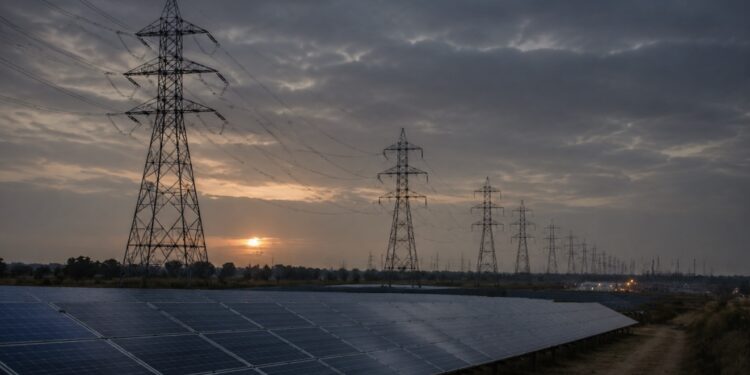
A Citi report data shows that rapid solar build‑out has eased daytime shortages but left the grid more vulnerable during evening and night peaks. The main challenge has turned from “not enough energy” to “not enough dispatchable energy at the ‘non-solar-hour’. India’s power planners must focus on dependability during non solar hours, rather than just adding more generation.
Over the past decade, India nearly doubled its peak demand, from roughly 119 GW in 2010 to about 250 GW in 2025. This upsurge is due to increased air‑conditioning use, industrial activity, electrification (including appliances and vehicles), and a boom in data centres.
Much of the new supply comes from renewables: solar installations have jumped, accounting for about 28.4% of India’s total capacity (55% of renewable capacity) as of March 2026. Wind, hydro and other renewables now make up over half the country’s capacity.
Solar generation now meets a significant slice of daytime demand, decreasing average deficits. For example, on April 25, 2026 (when demand hit a record 256 GW), solar plants supplied ~58 GW (about 24% of that peak).
Renewables (mainly solar and hydro) together supplied nearly 30% of total generation at that peak. By contrast, coal – still the single largest source – provided about 173 GW (66%). In practical terms, India’s grid met a historic peak without using any battery storage; the afternoon solar output was fully consumed.
[Also Read: SolarWinds Expands Global Presence With New Office in Bengaluru ]
As the DowntoEarth analysis says, India’s record peak occurred after solar output began to decline. In the late afternoon of April 25, solar generation had already peaked at about 80 GW and was declining as demand remained high.
Solar power hit its maximum during early afternoon, whereas the day’s highest demand (around 3:30–4:00 pm) came when solar output was weakening.
The Non‑Solar‑Hour Challenge
The Citi report shows that India is entering a new phase: ensuring “dependable power supply during non-solar hours”. The grid must manage when supply and demand are unsynchronised. Rising cooling loads and electrification have made demand more weather- and time-sensitive. As a result, nights and evenings could see shortages even if daytime generation is plentiful.
This trend shows up in several ways:
- Dispatchable capacity stress: With solar up to 80 GW installed, evening demand increasingly falls on thermal and hydro plants. But many coal units have limited ramping ability. Citi report shows the system is “tested during non-solar hours when cooling demand… remains high”. In fact, the highest afternoon demand (239 GW) was still sizable in the late evening of April 25 (around 212 GW). Without storage, fossil plants had to carry this load.
- Curtailment and bottlenecks: In 2025, grid data showed multiple episodes of solar curtailment (intentionally throttling solar output) between May and December. These stemmed from daytime overgeneration and limited network flexibility.
- Grid metrics and risks: Under the Central Electricity Authority’s (CEA) resource adequacy framework, there is already a risk of the Planning Reserve Margin going negative in non-solar hours for FY2027–29 if capacity additions lag. Without new flexible capacity or storage, evening reserves could fall below safe thresholds.
Experts summarise the shift succinctly: “The challenge is shifting from ‘not enough energy’ to ‘not enough dispatchable energy at the right hour’”. This means the focus moves from building any extra megawatts to making sure they are available when needed after sunset.
[Also Read: ABB invests in OctaiPipe to partner in AI-optimized energy efficiency for data centre cooling ]
What It Means
For grid operators and decision-makers, Citi’s analysis signals a need to recalibrate strategies. Key implications consist of:
- Investment in storage and flexibility: Battery Energy Storage Systems (BESS), pumped hydro, and other forms of stored energy become critical. Citi emphasizes that as renewables grow, “transmission and storage infrastructure will become increasingly critical”. Currently, only about 28.7 GWh of battery storage and 78.7 GWh of pumped hydro are under construction – modest compared to the need. Internationally, studies suggest India would ideally install roughly 13.5 GWh of battery storage for each 1 GW of average demand to cover the evening shortfall.
- Maintaining flexible generation: Coal remains essential in the near term. The report notes ~97 GW of new coal capacity is under construction or planning through 2032. Keeping these plants flexible (for example, lowering their minimum stable generation) is important. Analysis shows raising the minimum coal plant output floor from 55% to 40% of capacity could release ~34 GW more flexibility to absorb daytime solar without batteries.
- Grid management and market design: The draft National Electricity Policy 2026 explicitly aims to ensure “24×7 supply” reliability, recognizing that “hours matter, not just kilowatt-hours.”
- India is pioneering time-based procurement (e.g. round-the-clock tenders), which require renewables + storage to meet evening demand. These shifts correspond to Citi’s call to move from capacity addition to system dependability and flexibility.
- Demand-side measures: Shifting loads through pricing or demand-response can also help. For example, encouraging industrial or EV charging to happen in midday or night could flatten the duck curve. However, Citi’s focus is primarily on supply-side solutions.
Lessons from Abroad
In Europe, massive solar growth has likewise forced a pivot from pure capacity expansion to integration and storage. A Reuters analysis says Europe must now focus on “integrating networks, building storage capacity and operating intricate markets” rather than just adding generation. This echoes India’s situation: as solar becomes “too much of a good thing”, managing its intermittency is critical.
Similarly, experts point out that California’s duck curve scenario – high solar midday, steep evening ramps – required huge investments in energy storage and demand response. Indian analysts are now effectively sounding the same alarm. Energy consultant Debabrata Ghosh noted even in May 2026: “A solar-heavy system is able to meet peak demand during daytime… India needed more power storage infrastructure to meet demand increases when solar power is not available.”
Without storage, any solar-dominant grid will struggle after dark. Many countries like Germany, the U.S., and Australia have experienced comparable peaks and valleys as renewables grew. India’s advantage is its policy response – with round-the-clock renewables contracts and planned storage – striving to preempt a crisis.