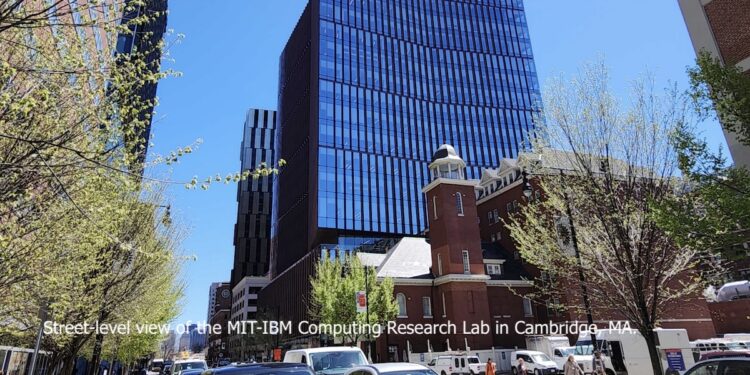
IBM and MIT are now treating AI, algorithms, and quantum computing as connected parts of one research agenda, not separate bets. The MIT-IBM Computing Research Lab is meant to advance hybrid computing systems that combine quantum hardware, classical systems, and advanced AI methods. That is a more ambitious target than a standard university-industry lab focused on one model or one use case.
Jay Gambetta, director of IBM Research and IBM Fellow, and IBM chair of the MIT-IBM Computing Research Lab, said, “We expect the MIT-IBM Computing Research Lab to emerge as one of the world’s premier academic and industrial hubs accelerating the future of computing. Together, the brightest minds at MIT and IBM will rethink how models, algorithms, and systems are designed for an era that will be defined by the sum of what’s possible when AI and quantum computing come together.”
From the MIT-IBM Watson AI Lab to a larger computing agenda
The new lab evolves from the MIT-IBM Watson AI Lab, which began in 2017 on MIT’s campus. According to MIT and IBM, the earlier lab helped establish a model for academic-industry collaboration and produced more than 210 research projects, involving over 150 MIT faculty members and over 200 IBM researchers. Those projects led to more than 1,500 peer-reviewed articles, and the lab supported more than 500 students and postdoctoral scholars.
The partnership has already built a track record in AI research, so the current move is less about starting from scratch and more about extending an existing research engine into quantum processing and hybrid systems. That is the practical reading of this announcement.
[ Also Read: IBM and Cisco Announce Plans to Build a Network of Large-Scale, Fault-Tolerant Quantum Computers
]
What the lab will study
The MIT-IBM research lab will focus on AI, algorithms, and quantum computing, with work centered on integration across those areas. IBM says the research agenda includes small and efficient modular language model designs, novel AI computing models, enterprise-focused AI systems, and quantum techniques for complex problems in fields such as materials science, chemistry, and biology. The work will also examine machine learning, optimization, Hamiltonian simulations, and partial differential equations.
This is a useful detail for readers because it shows the lab is not merely chasing large models or quantum hardware in isolation. It is trying to build the mathematical and systems-level foundation that future computing stacks may need. In plain terms, the research targets at methods, not just products.
IBM and MIT say the work could influence weather and turbulence prediction, financial prediction, protein structure prediction, medicine, and supply chains.
The lab links frontier research to domains that already have economic and scientific weight. If the collaboration produces usable algorithms or better integrated systems, the benefits would likely appear first in research-heavy industries rather than in consumer software.
[Related Reads: Wipro Partners with IISc to Drive Innovation in Quantum Computing and Advanced AI Technologies
]
Leadership and structure of the MIT-IBM research lab
The lab will be co-directed by Aude Oliva of MIT’s Computer Science and Artificial Intelligence Laboratory and David Cox of IBM Research. MIT and IBM have also named co-leads for the three focus areas: AI will be led by Jacob Andreas and Kenney Ng; algorithms by Vinod Vaikuntanathan and Vasileios Kalantzis; and quantum by Aram Harrow and Hanhee Paik.
The MIT-IBM research lab is not being managed as a single AI program with a quantum label attached. It has separate technical leads for each track, which is a sign that the partners expect the work to stay deep and specialized while still feeding into one joint platform.
IBM says it is targeting the world’s first resilient quantum computer by 2029 and is working on quantum-centric supercomputing that tightly integrates quantum machines with high-performance computing and AI accelerators. MIT says the new lab complements its Generative AI Impact Consortium and the MIT Quantum Initiative.
[Also Read: IBM Launches “IBM Bob,” an AI Development Partner for Enterprise Software Lifecycle” ]
That matters because it places the lab inside a larger research roadmap already underway at both institutions. The announcement is therefore not a standalone partnership headline. It is a progression of a longer effort to connect AI research with quantum science in a way that can survive beyond short-lived technology cycles.