Huawei unveils a full-stack data infrastructure solution for AI data centers, built around data lakes, AI data platforms, compute power, models, agent frameworks and data resilience. At the Huawei Innovative Data Infrastructure (IDI) Forum 2026 in Paris on May 21, 2026, the company said enterprises need to move their existing IT setups toward AI data center (AI DC) infrastructure as AI agents and inference workloads push token consumption higher.
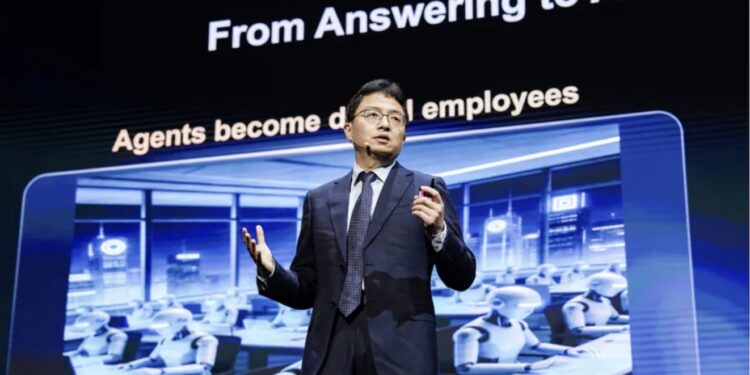
“AI is unlocking new opportunities for the IT industry”, Yuan Yuan, Vice President of Huawei and President of the Huawei Data Storage Product Line said, “The next chapter of AI is data. Committed to technological innovation in data storage, Huawei will accumulate the experience of industrial AI adoption, and work closely with the entire industry to help customers accelerate their journey into the intelligent era.”
In the company’s view, enterprises now need storage, data movement, model access, scheduling and security layers that can support large-scale AI use. Huawei said the new solution is meant to help organizations accelerate AI data center construction and move from traditional IT architecture to AI-first infrastructure.
[Also Read: India’s Data Infrastructure Boom Will Create an Entirely New Talent Segment ]
AI-focused data infrastructure solution
Huawei split the offer into four main blocks.
The first is an AI data lake, where Huawei said OceanStor Pacific Scale-Out Storage can deliver 11 PB of capacity in 2U, and DME Omni-Dataverse can support multimodal, cross-site and real-time data import with global visibility and retrieval from hundreds of billions of 1,000-dimension vectors in seconds. The company is positioning this as a way to keep AI systems supplied with usable data rather than raw storage alone.
The second block is the knowledge and memory platform, Huawei said its Context Memory Storage (CMS) is designed for ultra-scale inference clusters, supports heterogeneous computing power, and can reduce time to first token by 90%. For enterprise inference use cases, Huawei said its 3+1 AI data platform combines KV cache acceleration, a knowledge base with more than 95% retrieval accuracy, and an evolving memory bank, while Unified Cache Manager (UCM) is meant to improve inference accuracy by 30%.
The third part is model engineering and resource scheduling. Huawei said ModelEngine supports zero-code adaptation to new models and one-click deployment. It also said the platform uses fine-grained compute partitioning and intelligent scheduling, reaching an up to 1:10 xPU partitioning ratio so one accelerator can be used for multiple tasks.
The fourth piece is the agent framework. Huawei said ModelEngine Nexent can generate agents through natural-language interaction, which it says cuts rollout time by 80%. The company described this as a way to make agents easier to deploy and improve them continuously through optimization of skills, prompts and memory. Huawei also added a data resilience platform to address risks such as tool misuse, data poisoning, tampering and ransomware across agents, models, platforms and infrastructure.
[Also Read: Google and Blackstone Form AI Cloud Venture as Demand for AI Data Centers Surges ]
At the Huawei Innovative Data Infrastructure (IDI) Forum 2026, the company will set a broader direction for the industry. Yuan Yuan, vice president of Huawei and president of the Data Storage Product Line, said enterprises should build AI infrastructure around data lakes, AI data platforms, compute power, models, agent frameworks and data resilience. He also said the rapid spread of AI applications is driving a surge in enterprise token consumption and that the next chapter of AI is data.
Traditional data centers were optimized for storage, backup and app hosting. Huawei’s AI data center model is built around token-heavy inference, semantic retrieval, cache acceleration and agent workflows. That shift reflects how AI systems are being used now: less as isolated experiments, more as operational systems that must respond quickly and consistently.