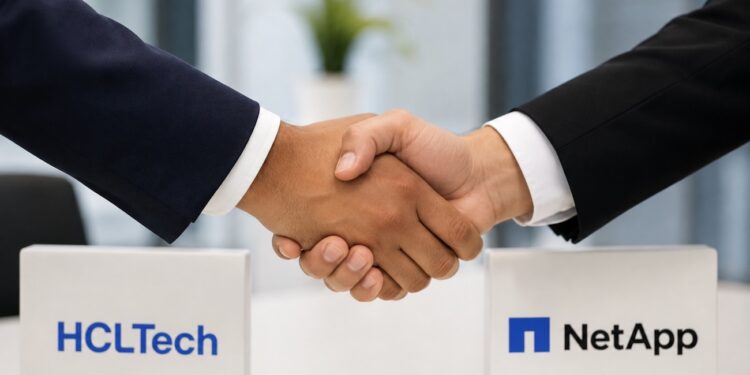
HCLTech and NetApp are expanding their partnership with a hybrid cloud storage-as-a-service offering. It is aimed at enterprises that need to scale artificial intelligence, generative AI, and other data-intensive workloads without committing to large upfront storage investments.
HCLTech’s Utility for Everything (U4X) digital infrastructure framework with NetApp Keystone, its consumption-based storage service. The combined model allows enterprises to increase storage capacity, performance and data services as workloads change, while supporting environments that span on-premises infrastructure plus public cloud.
“Our collaboration with NetApp reflects our focus on helping enterprises scale AI in a pragmatic and efficient way,” said Rampal Singh, Senior Vice President, Hybrid Cloud Business Unit at HCLTech. “By combining flexible infrastructure models with strong data management capabilities, we are enabling clients to unlock the value of their data and accelerate their AI journeys.”
According to HCLTech, the service can support both AI and GenAI applications and conventional enterprise systems. It is also connected with HCLTech’s AI Factory offerings for AI development, deployment and operations.
[ALSO READ: NetApp and Agastya Launch Data Explorers Lab to Advance Data & AI Education in India ]
What Is NetApp Keystone?
NetApp Keystone is a storage-as-a-service model in which customers consume storage through a subscription rather than buying all of the hardware capacity upfront.
NetApp says Keystone supports file, block and object storage across on-premises environments, colocations and public clouds. Its model allows customers to scale capacity according to workload requirements while using a common management approach.
Traditional infrastructure procurement usually involves estimating future storage demand, purchasing equipment and operating it for several years. That can create two problems: buying too much capacity that sits unused or buying too little and having to expand later through another procurement cycle.
NetApp’s current Keystone documentation describes billing around committed capacity and additional usage, with performance service levels based on requirements such as capacity, IOPS and latency.
For an AI workload, that flexibility can be useful because demand can change considerably between development, testing, production and peak periods.
“We believe strong partnerships are built by co-creating technology offerings, business models, solutions and services that deliver meaningful customer value. This collaboration gives customers access to NetApp’s intelligent data infrastructure through a flexible, accessible business model, backed by HCLTech’s hands-on expertise,” said Alvaro Celis, Chief Partner and Ecosystem Officer at NetApp.
What It Means for AI Projects Moving From Pilot to Production
One of the most important phrases in HCLTech’s announcement is the transition from AI pilots to enterprise-scale adoption.
That is where the infrastructure problem changes.
A pilot may use a limited amount of data and a handful of users. Production AI can involve thousands of users, continuous data ingestion, retrieval systems, model updates, backups and governance requirements.
Storage therefore becomes part of the application’s performance and reliability architecture.
The data also cannot simply be treated as a static collection of files. Enterprise AI increasingly depends on structured and unstructured data being available to models and applications at the right time.
NetApp’s AI Data Engine strategy embodies this wider shift toward data infrastructure built specifically for AI workloads.
The HCLTech partnership attempts to put a commercial model around that infrastructure.
HCLTech said the expanded offering builds on earlier deployments. The company mentioned a global food and beverage company that used a consumption-based approach to improve operational responsiveness and reduce upfront investment. It also mentioned a European telecommunications provider that used the model to improve scalability and resilience throughout distributed environments while meeting regulatory requirements.
For the food and beverage company, the stated issue was financial and functional flexibility.
For the telecommunications company, the issue included distributed infrastructure, resiliency and regulatory requirements.
Neither example proves that the offering will deliver the same result for every customer. But they show the kinds of enterprise problems the partnership is targeting.
[ALSO READ: HCLTech Launches AI Innovation Zone in Partnership With Google Cloud ]
The deeper story is that enterprise AI is forcing organizations to rethink how they provision data infrastructure.
HCLTech and NetApp are responding with a consumption-based model that combines U4X and Keystone. The aim is to let enterprises increase or adjust storage resources without rebuilding the underlying procurement and operational model each time their AI requirements change.
AI workloads make infrastructure demand more variable and make data management more central to application performance. A company that is uncertain about how large its AI environment will become may have a practical reason to prefer consumption-based infrastructure.
That is where the HCLTech-NetApp partnership becomes relevant.