Global IT spending is set to rise much faster in 2026 than Gartner expected earlier this year, now forecasting a total of $6.31 trillion, up 13.5% from 2025. Gartner says the upgrade is being driven mainly by AI infrastructure, software, and hyperscaler spending, with data center systems showing the sharpest increase in the forecast.
The new forecast is Gartner’s latest update for worldwide IT spending and was released on April 22, 2026. In February, Gartner had projected $6.15 trillion in 2026 spending, which implied 10.8% growth. The April revision is therefore a meaningful step up, reflecting stronger-than-expected demand for AI-related infrastructure and software.
The company says AI infrastructure and GenAI software are accelerating much faster than more traditional categories, creating a split market where some segments are expanding sharply while others are growing more modestly.
[Also Read: India’s IT Spending to Cross the $176 Billion Mark in 2026: Gartner Forecasts ]
AI growth driving the upgrade
Gartner’s forecast, “underscores the accelerating momentum in AI infrastructure and advanced memory.” The firm’s analysts say data center investment is rising quickly as AI workloads scale, which is pushing demand for high-performance compute, AI-optimized processors, accelerators, and supporting technologies.
“This latest forecast underscores the accelerating momentum in AI infrastructure and advanced memory,” said John-David Lovelock, Distinguished VP Analyst at Gartner. “As AI workloads scale, data center investment is ramping rapidly, which in turn is driving increased demand for high‑performance compute. This dynamic is creating meaningful growth opportunities for companies delivering AI‑optimized processors, accelerators, and enabling technologies.”
[Related Reads: Global AI Momentum Fuels Sovereign Cloud Surge, Gartner Forecasts $80 Billion Market in 2026 ]
That is the main reason the spending outlook changed; Gartner now expects data center systems spending to jump 55.8% in 2026, the fastest growth in any category it tracks. The segment is projected to rise from $505.6 billion in 2025 to $788.0 billion in 2026.
Where the money is going
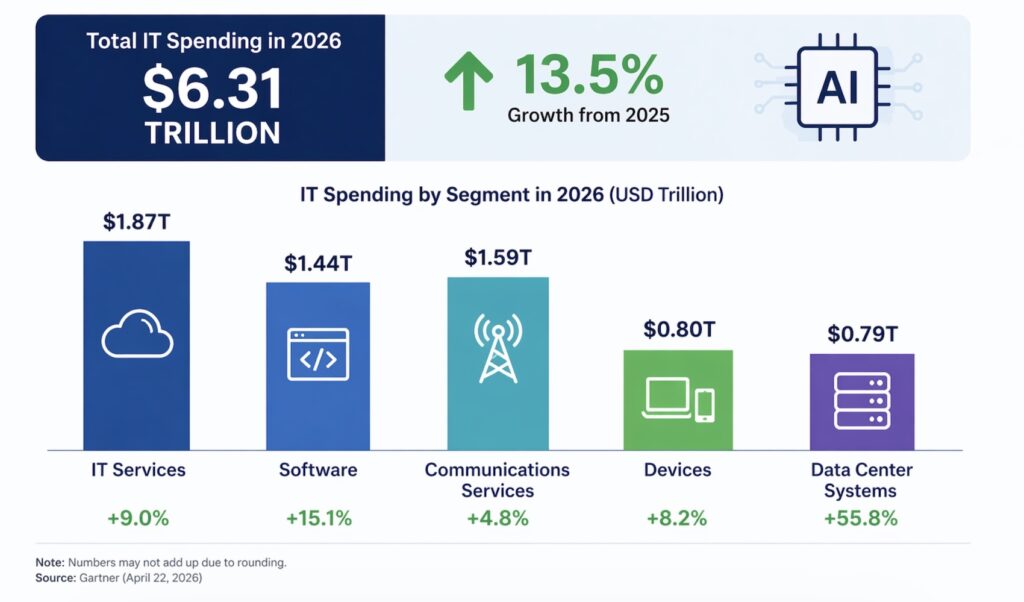
Gartner’s data shows that the largest overall IT spending category in 2026 will still be IT services, which it expects to cross $1.87 trillion. That category includes application implementation, managed services, infrastructure implementation, and IaaS. Software will be the next largest area at $1.44 trillion, followed by communications services, devices, and data center systems.
Gartner expects software spending to grow 15.1%, IT services to grow 9.0%, devices to grow 8.2%, and communications services to grow 4.8%. The spread shows how AI is pulling capital toward infrastructure and software first, while more mature spending categories move at slower rates.
One of Gartner’s clearer signals is that AI infrastructure is becoming the most attractive part of the technology market for vendors and investors. The firm says robust demand and supply constraints have pushed up prices for high-bandwidth memory, making the memory segment a particularly lucrative area for semiconductor makers.
Gartner’s February forecast already pointed to heavy AI infrastructure spending, but the April revision shows that the pace of capital allocation is accelerating rather than slowing. The firm now says hyperscaler purchases and AI-centric software are outperforming traditional IT categories by a wider margin than expected earlier in the year.
[Related Reads: Gartner Forecasts Global Semiconductor Revenue to Surpass $1.3 Trillion in 2026 ]
Big technology companies have committed at least $600 billion to data center spending this year, which gives additional context to Gartner’s revision. That scale of investment helps explain why data center systems and AI-enabling hardware are now growing much faster than most of the rest of the IT market.
What it means for enterprises
Gartner’s forecast suggests that companies are now funding AI through broader IT categories such as data center systems, software, and infrastructure services. That means procurement, infrastructure planning, and software modernization are becoming more tightly linked than before.
For vendors, companies selling AI-optimized servers, accelerators, memory, cloud infrastructure, and enterprise software are likely to benefit first. Companies tied to older refresh cycles or slower device replacement may see less momentum, since Gartner says device growth is still being held back by higher memory costs.
For investors, AI infrastructure and GenAI software are being revised upward, while other segments remain constrained by pricing pressure and slower replacement cycles. That creates a market where growth exists, but it is concentrated in a few specific layers of the technology stack.
The wider industry picture
Gartner’s forecast is also a reminder that AI spending is spreading beyond software into physical infrastructure. The company says hyperscale cloud demand is driving a sharp increase in server and data center investment, while GenAI continues to lift software spending, especially in model development. In other words, the AI cycle is now showing up in both the digital layer and the hardware layer of the IT market.
[Also Read: India’s IT Spending to Cross the $176 Billion Mark in 2026: Gartner Forecasts ]
The real question for the next phase is not whether IT spending is rising. It is where that spending concentrates, and how much of it goes into AI infrastructure versus general IT replacement.