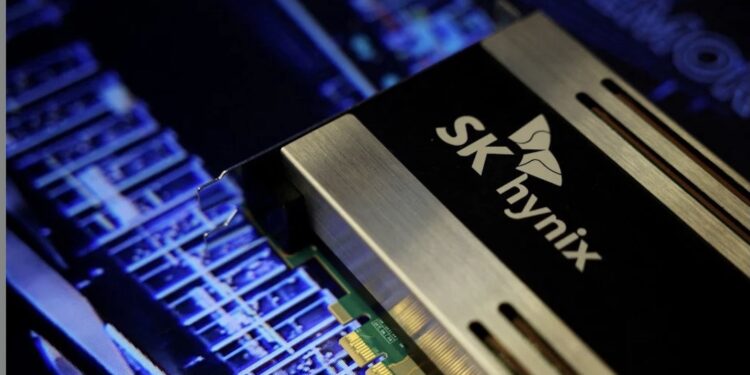
SK Hynix has crossed the $1 trillion market value as the AI boom continues to lift memory-chip makers into a higher valuation bracket. The company’s shares rose nearly 15%, taking its market capitalization to about 1,680 trillion won ($1.12 trillion). That made SK Hynix the third major chipmaker after Samsung Electronics and Micron Technology to reach the milestone.
On May 14, 2026, SK Hynix was already nearing the threshold, then valued at about $942 billion, after its shares had gained more than 200% in 2026 on top of a 274% rise in 2025. By the end of May 27, that valuation had become reality. The scale of the run shows how quickly AI demand has changed investor views of the memory business.
Samsung crossed the same threshold earlier in May, and Micron reached $1 trillion on May 26, placing three memory-linked chipmakers inside the same elite valuation group within days of one another.
[Also Read: Worldwide Semiconductor Market Posts Robust 21% Revenue Growth in 2025; AI Chips Drive Industry Realignment, Says Gartner ]
That sequence shows the AI rally is no longer centered only on GPU makers; memory suppliers are now part of the same trade.
Why SK Hynix Is Rising
The main driver of SK Hynix’s rise is demand for high-bandwidth memory (HBM), which is used in AI servers and advanced accelerators. The current rally is being fueled by AI-related demand for both conventional memory and HBM, while memory prices doubled in the previous quarter and were forecast to rise as much as 63% in the current quarter because of AI data center demand.
For memory companies, the difference between a commodity cycle and a strategic AI cycle is pricing power. The current market treats HBM capacity as a constraint, not a routine input, which has changed how investors value SK Hynix. This is an inference from the reported price trend, tight supply, and the size of the rerating.
[Also Read: Google and Blackstone Form AI Cloud Venture as Demand for AI Data Centers Surges ]
What Makes HBM Important
SK Hynix describes HBM as a memory technology built for very high bandwidth, which is exactly why it has become central to AI computing. SK Hynix’s research materials say HBM provides very high bandwidth, and its corporate materials describe SK Hynix as a leader in HBM and enterprise solid-state drives.
Actually, HBM sits next to AI processors and helps move data fast enough to keep those chips busy. This is different from older memory products that were judged mainly on cost and volume. As AI models grow larger and data center systems become more tightly packed, HBM has become one of the few components where performance, supply, and pricing all move together.
Impact on South Korea’s Market
The rise of SK Hynix is now a market-wide event, The South Korea’s KOSPI index is up 91% this year after a 76% rise last year, and that Samsung and SK Hynix together account for about half of the index’s market capitalization. That means the AI trade is carrying a large part of South Korea’s equity market.
South Korea is now the first country outside the United States to have more than one trillion-dollar company. That is a symbolic milestone, but it also shows how much of the country’s stock-market strength is tied to semiconductors.
[Also Read: AMD, Samsung Deepen Partnership to Advance AI Chips and Memory Technologies ]
Global Context and Comparison
Samsung Electronics passed the $1 trillion level earlier in May, while Micron crossed it on May 26, just one day before SK Hynix.
TSMC, the world’s largest contract chipmaker, has said the global semiconductor market could exceed $1.5 trillion by 2030, up from a previous $1 trillion forecast, as AI demand expands. That does not directly explain SK Hynix’s stock move, but it gives context for why investors are willing to pay up for companies tied to AI infrastructure.
What It Means
Memory chips are increasingly being priced as a core part of AI infrastructure, and that is the deeper meaning of SK Hynix’s trillion-dollar milestone. It reflects the growing view that AI systems need not only processors, but also fast and scarce memory to function at scale. This is an inference from the reported surge in HBM demand, pricing strength, and the parallel gains in Samsung and Micron.
South Korea’s market is now heavily concentrated in two AI-linked chip names, which makes the broader index more exposed if AI spending slows or memory prices weaken.