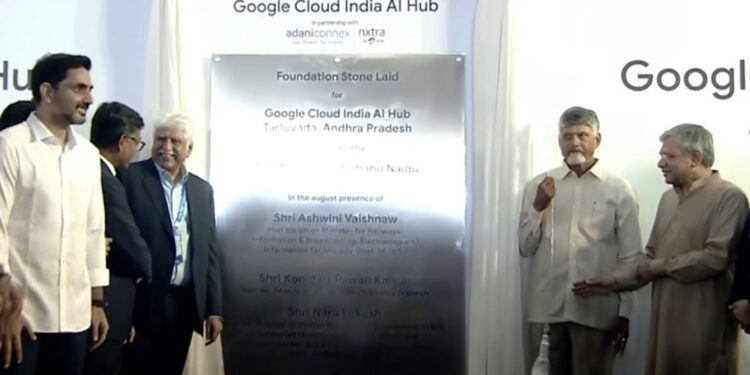
The foundation stone for the Google Cloud India AI Hub was laid today in Visakhapatnam, turning a long-planned data centre project into a visible construction milestone. The project sits inside a wider Google-Adani-Airtel infrastructure build and carries an announced value of about $15 billion over five years, from 2026 to 2030.
Google has said the hub will be its first AI hub in Visakhapatnam, India, and that it will include gigawatt-scale compute, a new international subsea gateway, and supporting energy infrastructure.
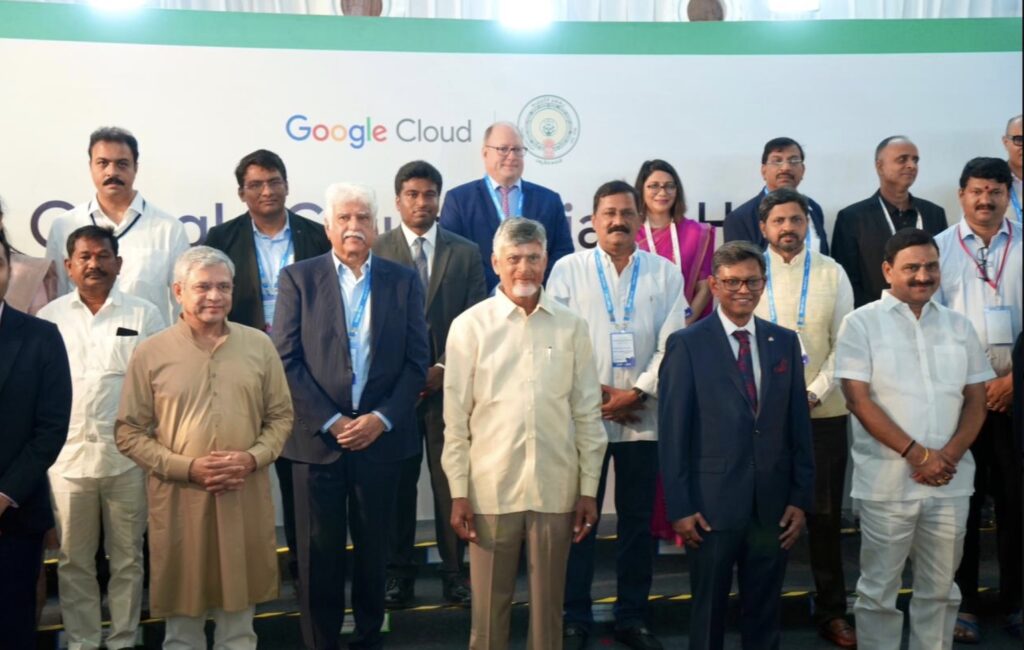
Andhra Pradesh Chief Minister N. Chandrababu Naidu laid the foundation stone in Visakhapatnam on Tuesday. The ceremony was part of the Adani-Google-Airtel data centre project and was attended by Union Minister for Electronics and IT Ashwini Vaishnaw, Union Minister Ram Mohan Naidu, and Jeet Adani. Google had earlier announced the $15 billion investment and that the project is being developed with AdaniConneX and Airtel Nxtra.
[ Also Read: India’s Tech Sector Set to Hit $315 Billion in FY26, Growth Edges Up to 6.1%: Nasscom Strategic Review 2026 ]
What Google is building
Google’s October 2025 announcement described the investment as its largest in India to date and said the plan would establish the company’s first AI hub in Visakhapatnam. The company said the project includes a major international subsea gateway that will bring multiple submarine cables to India’s east coast, adding route diversity to the country’s digital backbone and supplementing existing cable landings in Mumbai and Chennai. Google will also work with partners on new transmission lines, clean energy generation, and energy storage systems in Andhra Pradesh.
A planned capacity of 1 gigawatt, and said the site will be developed across nearly 600 acres in Tharluwada, Adavivaram, and Rambilli. Google’s campus in Visakhapatnam would have an initial capacity of 1 GW and described the investment as Google’s biggest ever in India.
The AI hub Visakhapatnam will be brought to life in collaboration with AdaniConneX and Airtel, and the development includes green energy infrastructure as well as data centre capacity. Adani said the project will support a wider 1 GW data centre infrastructure platform through AdaniConneX, which is a 50:50 joint venture between Adani Enterprises and EdgeConneX.
[ Also Read: Why US Tech Giants Are Betting Billions on India as Their Next AI and Data Center Hub ]
Google’s new AI hub in Visakhapatnam is intended to support not just local demand but global services as well, while also improving the strength of India’s digital network through the east-coast subsea route. That makes the Visakhapatnam project both a compute build and a connectivity build, which is a more complete infrastructure package than a standard cloud-region expansion.
What it means
For India, More AI and cloud infrastructure inside the country should reduce dependence on overseas comput, it will improve local availability for workloads that need scale, latency control, and regulatory comfort. The project gives Visakhapatnam a role that goes beyond a normal industrial or IT city. The state expects the project to support a multi-gigawatt digital ecosystem over time, and the government has framed the project as part of its “speed of doing business” policy. Whether that larger target is realized will depend on execution, power supply, subsea cable deployment, and how quickly the surrounding ecosystem comes online.
For Google, the company is pairing AI compute with physical infrastructure, network routes, and energy planning. Google said the project would be its largest AI hub outside the United States, and the latest foundation-laying event shows that the project has moved from announcement to implementation.
The larger context is India’s rising need for AI infrastructure. Google said the AI hub in Visakhapatnam will sit alongside a new subsea gateway and clean energy systems.
[Also Read: Adani Group Commits $100 Billion Investment to Build AI-Ready Data Center by 2035 ]
Adani described the project as one that will create tens of thousands of jobs across technology, construction, and clean energy. Those are company claims, not independently verified job counts, but they show the kind of industrial footprint the partners expect.