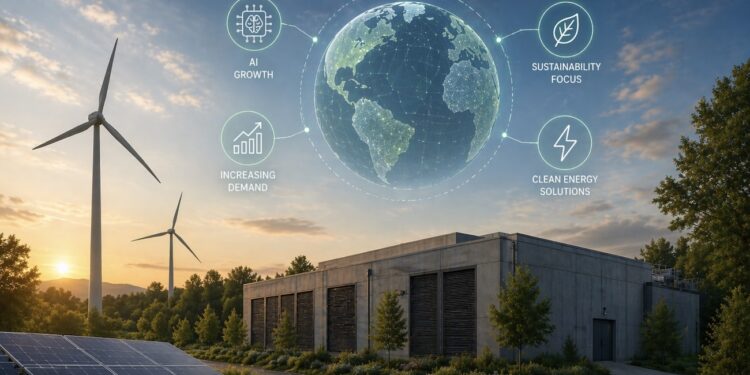
Earth Day 2026 arrives with a sharper business problem than in past years: the AI boom is pushing data center power demand higher. Companies are being asked to cut emissions and improve energy efficiency. The rapid rise of artificial intelligence is driving unprecedented demand for computing power, putting pressure on efforts to build sustainable data centers.
EARTHDAY.ORG’s 2026 theme, “Our Power, Our Planet,” is framed around community action and energy reliability, but it also fits the current tech debate unusually well. The International Energy Agency said electricity demand from data centres soared 17% in 2025, far ahead of global electricity demand growth of 3%.
Data centers are now part of the core conversation around AI, grid capacity, power prices, and climate targets. AI is the biggest driver of the next wave of data center growth, and the scale of that growth is already changing how utilities, regulators, and tech companies plan new infrastructure.
[ Related Reads: TCS and AMD Plan Rack-Scale AI Push in India with 200 MW Data Center Blueprint ]
AI growth is driving unprecedented demand
According to IEA, global electricity generation used to supply data centres is projected to rise from 460 TWh in 2024 to more than 1,000 TWh in 2030 and 1,300 TWh in 2035 in its base case. It also says data center electricity consumption could more than double to around 945 TWh by 2030, slightly more than Japan’s total electricity consumption today.

“AI-driven workloads are rapidly pushing rack densities beyond the limits of legacy air-cooled designs, rising from around 15 kW to as high as 60-120 kW per rack, making it increasingly difficult to scale without wasting enormous amounts of power and driving up operational costs to unsustainable levels. Facilities that were efficient two years ago are now facing power bills that threaten profitability and grid constraints that block expansion”, said, Jaideep Roy, Director, Business Development at IMS, Vertiv.
The pressure is especially concentrated in the United States, where data centres account for nearly half of electricity demand growth between now and 2030.
[ Related Reads: Microsoft Plans Major Cheyenne Datacenter Expansion with 3,200-Acre Land Purchase ]
Hyperscalers, including Microsoft, Amazon, Alphabet, and Meta, are expected to invest around $635 billion in AI infrastructure in 2026, which helps explain why power demand is rising so quickly.
The sustainability challenge becomes harder
The challenge of maintaining sustainable data centers is becoming more complex as AI workloads scale rapidly. Data centres accounted for about 1.5% of global electricity consumption in 2024, or 415 TWh, according to the IEA, and their local impact is much larger than that global share suggests. The United States accounted for 45% of global data center electricity use in 2024, followed by China and Europe.
That is why the policy response is starting to move; the U.S. Federal Energy Regulatory Commission plans to decide by June 2026 on new rules for managing data center interconnection and grid demand, and those rule changes could include requiring data centers to supply their own energy. Maine has also approved the first U.S. moratorium on new large data centers, reflecting rising concern over energy use, water use, and household electricity bills.
Industry leaders say the issue is no longer about whether sustainability matters, but how quickly it can be integrated into infrastructure planning.

Narendra Sen, CEO & Founder at RackBank Data Centers, said, “Sustainability can no longer be an afterthought for the data centre industry; it must be embedded into every rack, every watt, and every design decision. As AI adoption accelerates globally, the infrastructure powering it must evolve just as fast. The shift toward energy-efficient cooling, renewable power, and decentralised capacity in emerging cities is not just good environmental practice; it is the only responsible path forward.”
Industry response: efficiency, innovation, and renewable energy
Data center operators are not waiting for regulation alone; renewables are expected to meet nearly half of the additional electricity demand from data centres over the next five years, with natural gas and coal also playing a role and nuclear becoming more important later in the decade. That makes the energy mix a central part of the sustainability story, not an afterthought. Companies are now investing in renewable energy and efficient cooling systems to support more sustainable data centers.
Jaideep Roy highlights the need for a fundamental redesign rather than incremental upgrades, “The winning operators will be those who stop treating energy efficiency as a nice-to-have retrofit and instead engineer it into the DNA of every power and thermal system from day one.”
The market for clean power procurement is changing fast; developers are planning about 56 GW of on-site power generation for data centers, or roughly 30% of planned data center capacity, and many large buyers are seeking multi-gigawatt power purchase agreements, co-location with generation, and flexibility in how power is delivered. Renewable energy certificates remain a central tool because they are flexible and scalable.
What this means in practice is that sustainability is becoming a site-selection issue, a procurement issue, and a grid-planning issue at the same time.
Narendra Sen adds that sustainability and growth are not mutually exclusive, “Digital growth and environmental stewardship are not in conflict; they are complementary.”
The companies that can secure clean power, storage, and reliable interconnection fastest will have an advantage in rolling out AI infrastructure.
[ Related Reads: Tata Power and Andhra Pradesh sign MoU for renewable energy projects worth ₹49,000 crore ]
AI as both problem and solution
The most interesting part of the story is that AI is not only driving the power problem; it may also help manage it. According to the IEA, AI can help optimize complex energy systems by improving production, reducing costs, raising efficiency, improving uptime, cutting emissions, and boosting safety. In its analysis, AI applications in power plant operations and maintenance could deliver up to $110 billion in annual cost savings by 2035 and unlock as much as 175 GW of additional transmission capacity on existing lines.
The broader energy report also says AI could support better forecasting, smarter grid operations, and more flexible electricity use in buildings and transport.
The road ahead for sustainable data centers
The next phase is likely to be about flexibility; AI-era data centers may be better able to shift energy-intensive training work across sites, or reduce consumption when grids are under pressure.
Google has already announced contracts with utilities to lower consumption at certain data centers during peak demand, and other companies are testing similar approaches.
That is an important shift from the older cloud model, which expected constant load around the clock. The new AI model is forcing operators to think more like industrial energy users, with demand response, backup power, and workload shifting built into the design. If that transition scales, it could ease grid stress; if it does not, the cost of AI growth will increasingly show up in utility bills, permitting delays, and political resistance.

Pratap Mane, President & Country Head, India at Colt Data Centre Services, says the industry’s future will depend on how it manages this transition: “The industry’s long-term success will be defined not just by its ability to scale, but by how efficiently and sustainably that scale is delivered.”
He adds: “Sustainability is no longer a complementary objective. It is becoming fundamental to the future of digital infrastructure.”
Closing
Earth Day 2026 is a reminder that AI infrastructure is now part of the environmental conversation, not separate from it. The data is already clear: data center electricity use is rising fast, grid pressure is real, and regulators are paying closer attention. The companies that do best over the next few years will be the ones that treat power as a strategic input, not just an operating cost. AI growth can coexist with sustainability, but only if energy planning moves at the same speed as model training and cloud expansion. The future of digital infrastructure will depend on how effectively the industry can scale sustainable data centers without compromising performance.