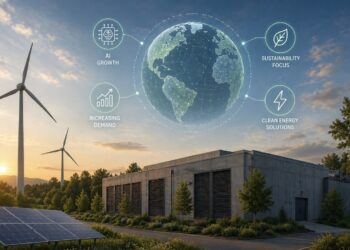

Enterprises worldwide are recognizing the importance of sustainability as climate change becomes more important during boardroom discussions —and new regulations loom. However, the focus on digital transformation is causing data centers to consume more energy than ever before.
According to Bloomberg, an optimistic projection suggests that by 2030, the information and communications technology (ICT) sector will consume approximately 8% of the world’s total electricity demand, compared to the 2% recorded in 2020. It is expected that storage as a proportion of data center (DC) energy consumption, will continue to expand and might account for as much as 38% of the overall DC power requirements by 2030 – making sustainability more important.
Before integrating technology to align with an organization’s environmental, social, and governance (ESG) objectives, it is crucial to first establish a baseline and subsequently define a target to systematically advance towards those goals. This entails adopting modern technologies specifically designed for the contemporary data center environment. Today there are companies that offer a comprehensive suite of solutions that assist organisations in this endeavor, empowering them to publish a sustainability dashboard accompanied by a sustainability scorecard. These solutions enable continuous optimization of energy consumption and maximization of resource utilization, aiding organizations in their pursuit of achieving their sustainability goals.
The selection of an appropriate storage solution for data centers assumes a pivotal role in the realization of sustainability objectives. By making an informed decision, organizations can contribute significantly to their environmental responsibilities while simultaneously advancing their digital transformation initiatives.
Here are five ways in which all-flash data centers can help enterprises achieve their sustainability goals:
1. Flash uses fewer watts per terabyte (TB) and less energy for cooling
The most significant sustainability benefit of flash-based storage over hard disk drives (HDDs) is its energy efficiency. Flash storage can support more data per watt of power consumed than HDDs. In a data center, this efficiency results in significant energy savings and lower carbon emissions.
2. Flash storage is the most efficient way of storing your data
Flash storage supports de-duplication, compression and compaction. These efficiency features allow users to store more data in a lesser storage footprint, thereby reducing the costs of running flash based storage systems. With decreasing costs, flash storage enables organizations to leverage its benefits on a larger scale, offering improved efficiency, faster data access, and enhanced reliability compared to traditional spinning disk storage.
3. Flash involves cleaner manufacturing and sourcing
The hard disk drive (HDD) manufacturing process involves the use of raw materials such as aluminum, glass, and rare-earth elements such as neodymium (Nd) and dysprosium (Dy) to make the magnetic media inside the drive. Rare earths are mined by digging vast open pits in the ground, which can contaminate the environment and disrupt ecosystems. When poorly regulated, mining can produce wastewater ponds filled with acids, heavy metals, and radioactive material that might leak into groundwater.
As opposed to HDDs, flash storage devices are more easily recyclable, because their NAND chips can be remanufactured using previously used components without significant security or privacy risks. It is important to note that both manufacturing processes have their own sustainability challenges, and efforts are being made to improve sustainability across the entire electronics industry.
4. Flash has the lowest cost per Input – Output (I/O), further lowering cost of operations for modern applications and digital workloads
Flash offers superior performance, even over nearline HDDs and hybrid SSD/HDD, which means it can handle more data in less time. Without powering spinning disks, flash delivers read speeds that are 10 times faster than HDDs. By reducing the time to access and process data, flash enables more efficient use of computing resources, which can help reduce overall energy consumption.
5. Flash costs less in the long run
It is significantly easier to invest in sustainability goals if there is a reliance on lower overall total cost of ownership (TCO) as a result of your efforts. While the initial cost of flash might still be slightly higher than that of HDDs in some cases, the TCO over the lifespan of flash-based storage is lower due to its reduced energy consumption, physical footprint, and lower maintenance costs. Hence, choosing flash-based storage over HDDs helps data centers bring down their carbon footprint in a small but measurable way and help contribute to a more sustainable future.
As the world continues to grapple with the challenges posed by climate change, it is crucial for businesses to adopt sustainable practices across all aspects of their operations. All-flash data centers offer an excellent opportunity for organizations to align their sustainability goals with their IT infrastructure and they are already beginning to recognize the potential of all-flash data centers in driving their sustainability goals.