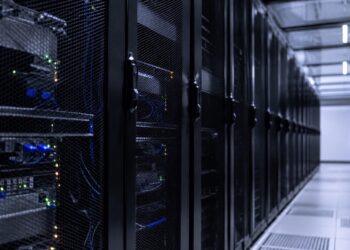
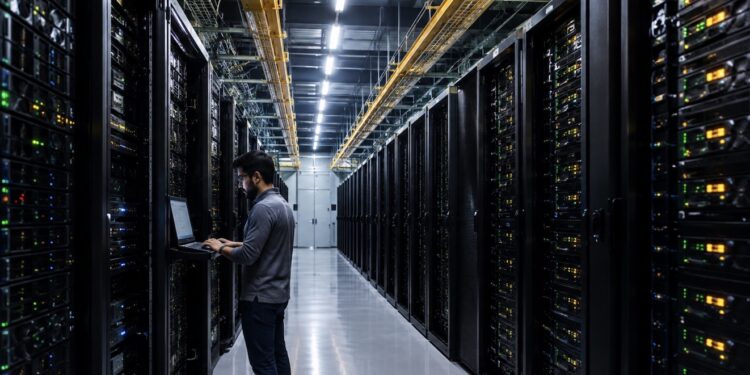
Larsen & Toubro (L&T) has secured a ₹10,000–15,000 crore order from US-based AI cloud company ‘Together AI’ to build a 10,000-GPU AI infrastructure facility at its Chennai campus. The project will use NVIDIA B300 accelerators and support AI training, fine-tuning and inference.
The project is being executed by LTN Compute, an AI infrastructure subsidiary of L&T’s Vyoma.AI business, and will be hosted at Vyoma’s Chennai data-centre campus. The facility is planned around 10,000 NVIDIA B300 GPUs and will support Together AI’s AI-native cloud platform.
L&T says the infrastructure will include more than GPUs. The AI Factory will bring together:
- high-density data-centre infrastructure
- high-performance networking
- low-latency interconnects
- high-throughput parallel storage
- AI infrastructure operations
- NVIDIA accelerated computing
“Artificial Intelligence is becoming foundational to every industry and AI Factories will power this transformation. Our deployment of an NVIDIA B300 AI Factory for Together AI marks a significant milestone in L&T’s Gigawatt AI Infrastructure Mission and reinforces our commitment to making India a global hub for next-generation AI infrastructure”, said Mr S N Subrahmanyan, Chairman & Managing Director, Larsen & Toubro.
The purpose is to provide the underlying infrastructure for large-scale AI training, fine-tuning and inference.
The project is also part of a much larger Chennai campus. L&T says the Vyoma.AI site is designed as a gigawatt-scale campus, with the first phase planned for 250 MW and power infrastructure readiness of 150 MVA.
[ALSO READ: IBM and Together AI Sign $240 Million Deal to Scale Open-Source AI Inference ]
An AI factory requires the power, cooling, networking and storage architecture to be designed around extremely dense accelerator workloads.
The Numbers Behind the Deal
| Metric | Detail |
| L&T order value | ₹10,000–15,000 crore |
| Lower end of reported US-dollar value | About $1.05 billion |
| Upper end | About $1.57 billion |
| Planned GPUs | 10,000 NVIDIA B300 |
| Location | Chennai, Tamil Nadu |
| AI cloud customer | Together AI |
| Campus scale | Gigawatt-scale |
| First-phase design | 250 MW |
| Power infrastructure readiness | 150 MVA |
L&T’s project includes these infrastructure layers, which is why the company is treating the development as its entry into the AI Factory business rather than simply another data-centre construction contract.
Why Chennai?
The location is part of the story. L&T’s Vyoma.AI campus in Chennai is already being developed as a large-scale data-centre site. The company says the campus can scale toward gigawatt capacity, while the first phase has a 250 MW design.
A large AI cluster needs reliable power and a facility capable of supporting high-density computing for many years.
Once a campus has the required electrical network, cooling systems, fibre connectivity and operational system, additional AI capacity can be added more efficiently than building each cluster from scratch.
India’s Five Major AI Infrastructure Projects to Watch
1. Yotta’s Blackwell Ultra Supercluster: 20,736 GPUs
Yotta announced in February that it would deploy 20,736 NVIDIA Blackwell Ultra GPUs, making it one of the largest disclosed AI superclusters in India and Asia. The company said the deployment represented more than $2 billion of investment, with the supercluster planned at its 60 MW D2 data centre in Greater Noida and additional capacity from its Navi Mumbai campus.
2. L&T and Together AI: 10,000 B300 GPUs
The new Chennai project has a planned 10,000 NVIDIA B300 GPUs and an order value of up to ₹15,000 crore. The facility is intended for Together AI’s cloud platform and will support training, fine-tuning and inference.
3. Yotta and Gorilla Technology: More Than 5,000 GPUs
In March, Gorilla Technology and Yotta announced a deployment involving approximately 640 NVIDIA HGX B200 servers with more than 5,000 GPUs for AI workloads in India. The partners said the agreement was expected to contribute more than $500 million in revenue over five years.
This is another important reference point because it illustrates the rapid increase in multi-thousand-GPU deployments in India.
4. NxtGen AI: More Than 4,000 Blackwell GPUs
NxtGen AI announced a national-scale sovereign AI factory using more than 4,000 NVIDIA Blackwell GPUs through Dell Integrated Rack Scalable Systems. Vertiv is providing the power and thermal infrastructure, while Dell provides the integrated compute platform.
The facility is designed for high-performance training and inference and is intended to operate within NxtGen’s sovereign cloud framework.
5. L&T and NVIDIA Gigawatt-Scale AI Infrastructure
L&T’s earlier February agreement with NVIDIA is different from the new 10,000-GPU Together AI order.
The February announcement laid out a wider gigawatt-scale AI factory infrastructure programme, including a plan to scale the Chennai GPU cluster toward 30 MW and establish a 40 MW data-centre facility in Mumbai. The public announcement did not disclose a comparable GPU count for the complete programme, so it should not be ranked against the other projects purely on the basis of GPUs.
The significance here is the campus and power scale, rather than a disclosed accelerator count.
“Making AI globally accessible is going to be the biggest infrastructure build-out in human history, and L&T understands that”, said Mr Vipul Ved Prakash, Co-founder & CEO, Together AI. “That’s exactly why we partnered with them— to bring the scale, resilience and engineering excellence this moment demands to India.”
What It Means for India’s AI Infrastructure
India’s AI strategy has increasingly moved beyond model development toward the question of where the computing resources will come from.
The government said in March that more than 38,000 GPUs had been onboarded through the IndiaAI compute portal, with the wider IndiaAI Mission designed to expand access to high-performance computing for startups, researchers and other users. The mission has an overall outlay of ₹10,372 crore.
Government-supported compute
Sovereign AI clouds
Private GPU cloud platforms
Enterprise AI clusters
Hyperscale and gigawatt-scale data centres
The L&T project fits into the private, commercial end of that infrastructure market.
The Power Problem Behind the GPU Race
A cluster of thousands of AI accelerators needs considerable electrical capacity, and the data centre must be designed to deliver that power continuously.
L&T says its Chennai campus has a 250 MW first-phase design, with 150 MVA of power infrastructure readiness.
The 250 MW figure relates to the wider first-phase campus design and should not be treated as the cluster’s direct GPU power draw.
Still, it illustrates the direction of the industry: modern AI infrastructure is becoming a power and cooling engineering challenge as much as a computing challenge.
Research on large AI clusters has similarly identified power availability and management as major constraints as accelerator deployments move into the hundreds of megawatts.
[ALSO READ: Adani Group Commits $100 Billion Investment to Build AI-Ready Data Center by 2035 ]
India Is Moving From AI Consumption to AI Infrastructure
For several years, India’s AI story was largely about software development, IT services and adoption of models built elsewhere.
India is now investing in the physical systems required to train, fine-tune and run AI at scale.
A 10,000-GPU cluster does not by itself create an AI ecosystem. But it creates a piece of infrastructure that researchers, companies and AI cloud platforms can actually use.
That matters because AI availability is increasingly constrained by compute.
The government is expanding common compute capacity. Private companies are building sovereign clouds. Data-centre operators are increasing power capacity. Infrastructure companies are developing high-density AI campuses. And NVIDIA is supplying the accelerated computing platform connecting many of these projects.
[ALSO READ: Microsoft Opens Largest India Cloud Hub in Hyderabad to Meet Rising AI Demand ]
A 10,000-GPU AI cluster requires infrastructure built for sustained high-density computing. Power has to be available. Cooling has to work reliably. Networking has to move data between thousands of accelerators. Storage has to keep those accelerators supplied with data. Software has to schedule the workloads. And a commercial customer has to generate enough demand to justify the investment.