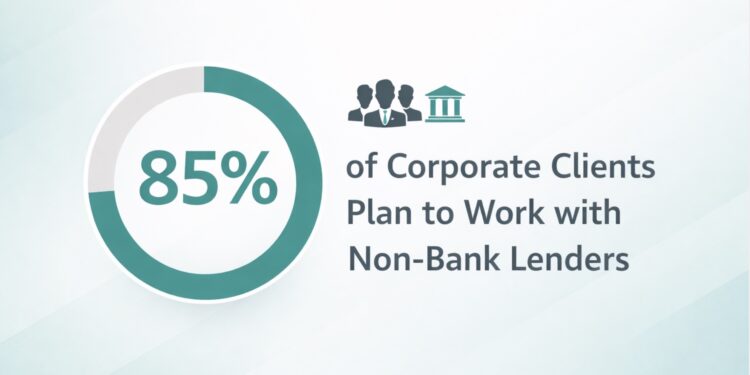
Capgemini Research Institute’s latest World Corporate and Investment Banking Report 2026 says corporate and investment banking is under pressure from a clear shift in client behavior. 85% of corporate clients plan to engage with non-bank financial institution within the next 12 months. Capgemini says these clients are looking for faster, more transparent, and more responsive services than they say they are getting from traditional corporate and investment banks.
The report is based on surveys of 750 senior executives across corporate and investment banks, large corporations, and non-bank financial institutions, all with annual revenue of at least USD 1 billion. Capgemini says the study points to a market where banks are still important, but no longer the default option for many corporate clients.
Why is this shift happening
The report says the change is being driven by a mismatch between client expectations and bank delivery. Corporate clients want real-time responsiveness (58%), personalized engagement (49%), and innovative solutions (40%). Yet only 23% say corporate and investment banks currently meet those needs. Capgemini also says clients are frustrated by weak integration with ERP and treasury systems, which forces manual workarounds for 92% of respondents, along with a lack of personalization (89%) and limited analytics and forecasting capability (68%).
The report shows that banks are losing ground where corporate clients care most: speed, flexibility, and workflow integration. That is why non-bank financial institutions are gaining attention now.
Big opportunity for fintech and private capital
The report makes clear that non-bank players are benefiting from the gap; these include private capital firms, alternative lenders, and other financial institutions that can move faster and tailor products more easily than large banks. Capgemini’s findings suggest that this is not just a one-off client shift; it is becoming a structural opening for fintech and private capital providers in corporate finance.
Capgemini findings say banks are trying to respond by broadening their own product mix; more than half of executives surveyed are exploring tokenized products (51%) to unlock new fee streams through digital custody, token issuance, and premium services. The report says 77% are prioritizing real-time treasury capabilities for cross-border payments, and 65% are looking at next-generation AI market products for algorithmic trade execution, hedging, and research insights.
Technology is now a competitive weapon
The report argues that technology is no longer a support function in banking; it is now a competitive tool. Capgemini says only 29% of IT budgets are currently directed to transformative technologies, while 43% goes to running and maintaining legacy systems. It also says 61% of CIB executives are constrained by high compliance costs. Spending patterns help explain why many banks are still stuck in pilot mode on AI and other modernization efforts.
The firm says non-banks are closing the competitive gap, and that many banks are struggling to move beyond pilots because AI governance remains weak. The report says only 26% of banks operate with centralized AI oversight.
“Non-banks are closing the competitive gap with established corporate and investment banks. Client demands have shifted dramatically, and while CIBs have invested heavily in AI, many are struggling to move beyond the pilot stage. A key reason is governance – only 26% of banks operate with centralized AI oversight, making teams hesitant to automate crucial business processes,” said Catherine Chedru-Refeuil, Global Head of Corporate and Investment Banking at Capgemini. “To succeed, CIBs must adopt a disciplined approach: creating enterprise-grade platforms and cultivating an ecosystem of trusted partners. Early adopters will see tangible benefits in the form of deeper client engagement, improved fee income, and materially lower costs.
The report says current innovation programs are also underdelivering; 82% of respondents said innovation efforts are not producing improved revenue from new products, while 51% said those efforts are not generating expected cost savings. Banks are looking to strengthen AI skills through hiring, with 40% planning to bolster AI expertise through external hires because upskilling remains difficult.
In short, Capgemini’s study shows a market at an inflection point; traditional banks still have scale, but non-bank financial institutions are gaining because they match client needs more closely on speed, flexibility, and digital experience.
[Also Read: Capgemini’s World Payments Report 2026 Reveals Merchant Exodus from Traditional Banks ]