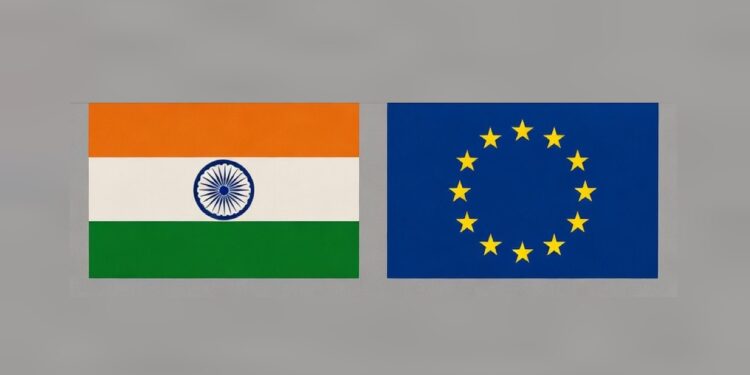
In a historic breakthrough after nearly two decades of often arduous negotiations, India and the European Union today announced the successful conclusion of a comprehensive Free Trade Agreement (FTA), hailed by leaders on both sides as the “mother of all deals. India EU deal aims to liberalise tariffs on both sides, with the European Union opening 96% of its tariff lines and India 92%.
The announcement came on January 27, 2026, during the 16th India-EU Summit in New Delhi, coinciding with Republic Day celebrations, where European Commission President Ursula von der Leyen and European Council President António Costa joined Prime Minister Narendra Modi as chief guests. Modi described the pact as a “long-pending landmark trade deal” that unites two major economies representing about 25% of global GDP and nearly one-third of world trade, creating a combined market of roughly two billion people.
European officials emphasized the deal’s scale and timeliness amid rising global trade uncertainties, including protectionist pressures from the United States. The agreement covers goods, services, investment rules, and other trade disciplines, while separate but parallel talks addressed investment protection and geographical indications.
Tariff Liberalisation and Sectoral Opening
Tariff Relief and Market Access: Under the deal, India has agreed to eliminate or significantly reduce tariffs on a substantial portion of EU exports. According to the European Commission and multiple official statements, duties will be cut or removed on over 96% (with some sources citing 96.6–97%) of EU goods, delivering annual duty savings of up to €4 billion for European exporters.
Automobiles: Tariffs on EU made passenger cars, previously as high as 110%, will be phased down, with an initial reduction to around 10% over time, broadening access for European manufacturers.
Wines and spirits: Duties, previously as high as 150%, will progressively decline to as low as 20–30%.
Processed foods: Tariffs currently at 50% on items such as chocolate, pasta, biscuits, bread, pastries, and related products will be eliminated entirely.
Oils and related products: Olive oil, vegetable oils, and margarine (previously 45%) will attract zero duties.
Other categories: Zero or reduced tariffs apply to machinery, electrical equipment, aircraft and spacecraft, optical/medical/surgical instruments, plastics, chemicals, pharmaceuticals, iron and steel, pearls/precious stones/metals (covering significant volumes), fruit juices, non-alcoholic beer, and sheep meat.
The deal gives Indian exporters preferential access to the European Union, something India previously lacked, while competitors already enjoyed it.
Benefits for India
While the deal delivers major gains for European exporters, it also secures meaningful advantages for businesses in India. Enhanced access to the EU market, already India’s largest goods trading partner, is expected for labour-intensive sectors such as textiles, footwear, gems and jewellery, leather goods, electrical machinery, and chemicals. Bilateral goods trade stood at approximately €120 billion ($139 billion) in recent years, with services adding further depth.
The agreement extends beyond tariffs to include improved market access in services (notably financial and maritime), procurement opportunities, and rules to facilitate trade and investment.
The India EU deal is designed to boost Indian exports of labour-intensive goods, such as textiles, leather, gems, jewellery, footwear and electronics by securing reciprocal access in the EU market.
The pact also dovetails with complementary dialogues on investment, services, digital trade, and standards cooperation.
Prime Minister Modi emphasised that the agreement covers economies representing 25% of global GDP and one-third of global trade, a framing intended to signal India’s evolving role in global economic governance.
Despite today’s announcement, the deal is not yet in force. It must undergo legal vetting and parliamentary ratification in the European Parliament and approval by India’s cabinet before formal implementation.
Agriculture and dairy sectors remain mostly excluded or subject to protections to safeguard domestic producers.
Indian officials expect this process to take several months, with the agreement likely to enter into force in early 2027.
Also Read: 5 Future-Ready Skills Every Storage Engineer Should Build in 2026