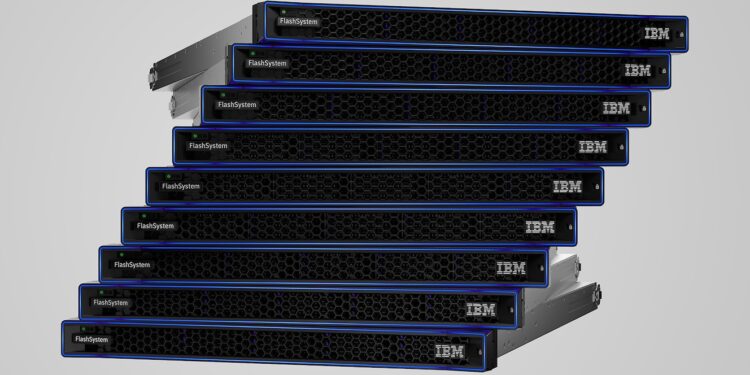
In a major update to its enterprise storage leadership, IBM introduced the next generation of its FlashSystem portfolio, marking a pivotal shift toward autonomous storage operations powered by AI agents. The company says the new systems will help organisations reduce the burden of routine storage management while delivering stronger performance with security.
Three New FlashSystem Models for Diverse Needs
IBM’s latest portfolio includes three flagship systems: the FlashSystem 5600, FlashSystem 7600, and FlashSystem 9600. Each targeting different scales of deployments and performance needs:
- IBM FlashSystem 5600 is the most compact of the three, ideal for smaller environments, edge sites, and remote offices. In a single 1U rack footprint, it offers up to 2.5 petabytes (PB) of usable capacity and supports up to 2.6 million IOPS, combining dense storage with strong throughput in tight spaces.
- IBM FlashSystem 7600 steps up scale and performance for mid-to-large organizations. In a 2U form, it delivers as much as 7.2 PB of effective capacity and up to 4.3 million IOPS, making it suitable for virtualized environments, analytics workloads, and consolidated application platforms.
- IBM FlashSystem 9600 represents the top tier of the portfolio, built for mission-critical enterprise workloads. It offers nearly 11.8 PB of capacity and up to 6.3 million IOPS in a single 2U system. Organizations running core banking systems, ERPs, and high-performance AI applications are expected to benefit most from this model.
IBM stresses that all three systems deliver meaningful improvements in data efficiency, up to 40% better compared with the previous generation, and can significantly lower storage footprint and operational costs.
AI Agents Bring Autonomous Data Services
FlashSystem.ai, a new suite of AI-driven data services intended to turn storage from a passive repository into an active, self-managing infrastructure layer. Rather than simply providing dashboards or alerts, FlashSystem.ai embeds agentic AI agents into storage arrays so they can monitor, diagnose, tune, and even remediate issues throughout the data path with minimal human involvement.
This means the system can automatically perform thousands of automated decisions every day. According to IBM, these capabilities can cut manual storage operations, such as provisioning, reporting, and compliance tasks, by up to 90%.
FlashSystem.ai learns over time by analysing billions of data points collected across telemetry flows. This model-based intelligence allows the system to adapt to enterprise workloads, suggest tailored recommendations to administrators, and even generate documentation to support audits or compliance reviews.
Built-In Resiliency and Security
Resilience and data protection have become main priorities for storage infrastructure. The new FlashSystem portfolio addresses this challenge by integrating a fifth-generation FlashCore Module, a proprietary all-flash storage drive that offers hardware-accelerated analytics and real-time threat detection.
IBM says the new FlashCore Modules analyze every input/output (I/O) operation with built-in telemetry and AI classification, enabling anomaly and ransomware detection in under 60 seconds. These capabilities are delivered without any noticeable performance impact, a key requirement for enterprise workloads where predictable latency is essential.
The portfolio also layers these detection capabilities with automated recovery recommendations and integration with IBM’s broader cyber resilience technologies.
The products are scheduled for general availability on March 6, 2026.
Also Read: One-Third of Nations to Be Locked into Regional AI Platforms by 2027, Gartner Warns