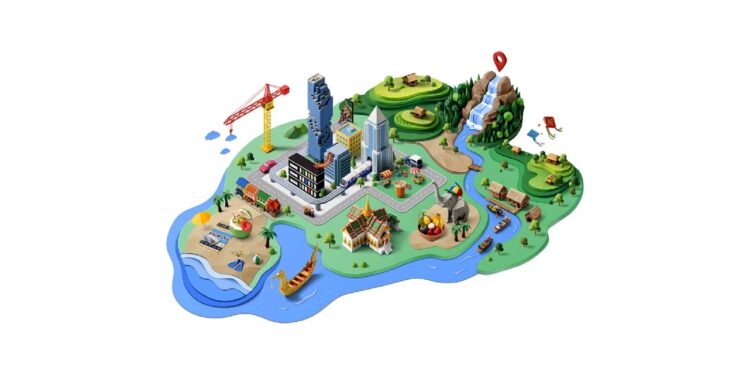
Today, Google Cloud launched a new cloud region in Bangkok, Thailand, the region is now operational and available to enterprise, public sector, and developer customers.
The launch is part of Google’s previously announced US$1 billion investment to expand cloud and data centre infrastructure in Thailand. The Bangkok cloud region is designed to serve local and regional demand for cloud computing, data processing, and AI related services.
Google’s cloud region in Thailand enables organisations to store and process data within the country, with local regulations and compliance, including Thailand’s Personal Data Protection Act (PDPA). It is built with multiple availability zones to increase reliability and uptime for mission-critical systems.
The region promises low-latency performance for Thai businesses and users by placing compute and storage resources physically closer to end users. The cloud region integrates with Google’s global network, spanning over 40 cloud regions worldwide.
Google Cloud estimates that the Bangkok region will generate major economic value for Thailand, estimated at THB 1.4 trillion (approximately US$41 billion) over the next five years. It is also anticipated to support an average of 130,000 jobs annually during this period.
Karthik Narain, Chief Product and Business Officer, Google Cloud, said: “Our new Thailand cloud region brings the same world-class infrastructure that powers Google’s global services directly to Thai enterprises, startups, and public sector institutions. With access to Google Cloud’s leading cloud and AI technologies, we’re giving Thai organizations a foundation for growth in the AI era, allowing them to innovate faster with greater control over their data.”
A cornerstone of the region’s value proposition is access to Google’s AI tools and platforms, including Vertex AI and Gemini models. Google highlights initiatives such as PanyaThAI and ChaiyoGCP, aimed at upskilling Thai developers and enterprises in cloud computing and AI.
Also Read: Technology trends redefining how enterprises will operate in 2026