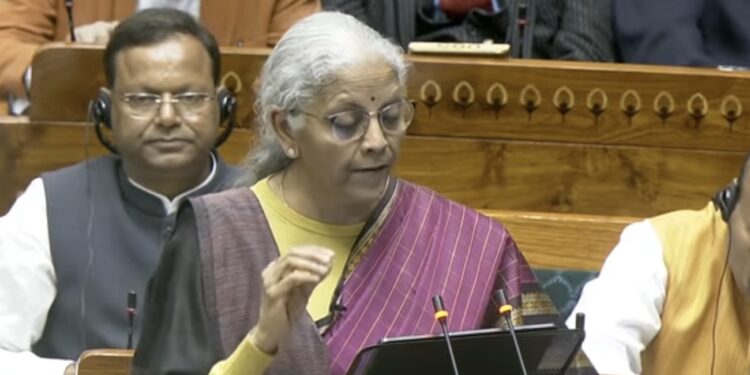
Finance Minister Nirmala Sitharaman, today, Sunday, 1 Feb 2026, presented the Union Budget 2026 in Parliament. India’s gross fiscal numbers suggest continued focus on balancing growth with discipline.
Below are the key highlights from the Union Budget 2026.
Record Capital Expenditure Push
The Budget 2026 records capital expenditure of ₹12.2 lakh crore, the highest ever. Sitharaman announced 7 high-speed rail corridors that run between Delhi –Varanasi, Varanasi – Siliguri, Mumbai – Pune, Pune – Hyderabad, Hyderabad – Bengaluru, Hyderabad – Chennai and Bengaluru – Chennai.
The government also plans to develop 20 new national waterways over the next five years.
Manufacturing
The Budget 2026 announced the India Semiconductor Mission 2.0, which aims to boost domestic production of semiconductor equipment and materials, promote indigenous full-stack IP design, and strengthen supply chain resilience.
The initiative prioritises industry-led research and training infrastructure to enhance technological capabilities and develop the workforce.
The Electronics Components Manufacturing Scheme (ECMS), launched in April 2025 with an initial outlay of Rs. 22,919 crores, has attracted investment commitments exceeding 200% of its target. The Electronics Components Manufacturing Scheme outlay increased to ₹40,000 crore.
In the pharmaceuticals sector, Sitharaman announced the Biopharma SHAKTI programme, a ₹10,000 crore initiative spread over five years. It aims to position India as a global biopharma hub, including a network of 1,000 accredited clinical trial sites
The Budget also proposed rare earth mineral corridors across Odisha, Andhra Pradesh, Tamil Nadu, and Kerala, along with chemical parks.
MSMEs and Entrepreneurship
In her Budget speech, Finance Minister Nirmala Sitharaman proposed the launch of a dedicated ₹10,000 crore SME Growth Fund, aimed at strengthening micro, small and medium enterprises (MSMEs) across India.
MSMEs should know that the Fund isn’t a blanket grant; support is targeted to enterprises that meet pre-defined criteria, such as productivity gains, formalisation milestones, or export readiness.
Technology, AI and the Data Centre
This budget 2026 speech mentions AI more than ever before, signalling it as a core pillar of national economic and tech policy rather than a niche area of support.
Sitharaman announced “Bharat Vistar,” a Virtually Integrated System to Access Agricultural Resources. This will enhance farm productivity, enable better decisions for farmers and reduce risk by providing customised advisory support.
The government announced a tax holiday until 2047 for foreign cloud and hyperscale data centre providers if they deliver services worldwide from data centres located in India.
Education, Skills and the Future Workforce
The Finance Minister proposed A high-powered “Education to Employment and Enterprises” Standing Committee. Its mandate includes aligning formal education with industry needs and assessing how technologies (including AI) will reshape skill requirements and jobs.
She also announced the establishment of content creator labs in 15,000 schools and 500 colleges. Focus will be on animation, visual effects, gaming, and digital media as part of future-ready skill development.
Green Growth and Climate Action
The Budget 2026 allocated ₹20,000 crore over five years for Carbon Capture, Utilisation and Storage (CCUS) technologies.
Financial Sector and Reforms
Sitharaman announced the formation of a High-Level Committee on banking sector reforms. The aim will be to improve governance, efficiency, and credit delivery. This committee will cover commercial, co-operative banks and NBFCs, providing a roadmap for reforms and modernisation of the sector.
The Finance Minister proposes restructuring two major public sector NBFCs, Power Finance Corporation (PFC) and Rural Electrification Corporation (REC).
She reiterated the government’s focus on regulatory simplification, GST rationalisation, and decriminalisation of minor offences to improve the ease of doing business.
Also Read: How CIOs and CISOs Can Govern AI Without Slowing the Business