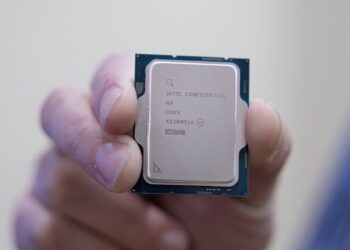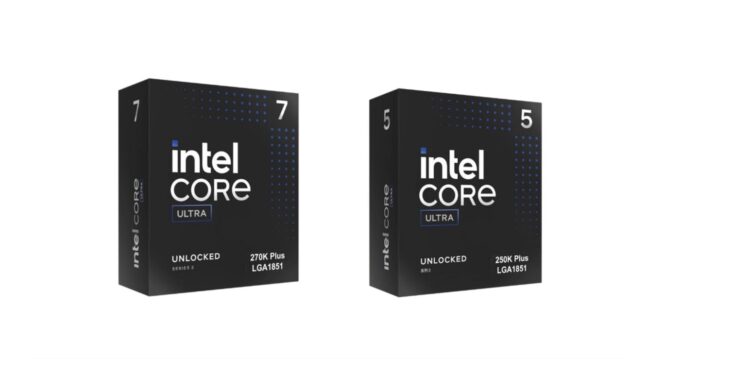
Intel has introduced the Core Ultra 200S Plus series desktop processors, the 270K and 250K Plus. The company positions the Core Ultra 7 270K Plus and Core Ultra 5 250K Plus as higher-value, enthusiast-oriented parts that raise core counts, increase the die-to-die (D2D) link frequency, and add new software optimisation capabilities.
- Two principal SKUs: Core Ultra 7 270K Plus and Core Ultra 5 250K Plus. Intel says the chips bring more cores (notably additional efficiency cores), higher D2D frequency, and support for faster DDR5 memory and emerging 4-Rank CUDIMM modules.
- Official availability is March 26, 2026; suggested retail prices start at $299 for the 270K Plus and $199 for the 250K Plus.
Key technical changes
- Core counts and clocking: Intel reports the 270K Plus increases efficiency cores (E-cores), so the 270K Plus totals 24 cores (8 P + 16 E) while the 250K Plus totals 18 cores (6 P + 12 E). The launch materials also list substantial boost clock figures and a die-to-die frequency bump of up to ~900 MHz versus the preceding non-Plus SKUs.
- Memory and platform: The Plus parts officially support DDR5-7200 MT/s (up from DDR5-6400 on non-Plus 200S chips), and Intel highlighted early support for 4-Rank CUDIMM, an emerging module type that can offer very high per-module capacity. Compatibility with existing 800-series motherboards is retained, with new 800-series boards due later in 2026 for fuller feature support.
- Software optimisation, Intel Binary Optimisation Tool: Intel is introducing what it calls the Intel Binary Optimisation Tool (sometimes referenced as a binary translation/optimisation layer) that the company says can improve native performance in selected games by translating or reoptimising binaries at run time. Intel frames this as a way to raise instructions-per-cycle (IPC) for workloads not originally compiled for this silicon. Independent coverage notes Intel is positioning this as part of the performance story rather than a purely silicon change.
Performance claims
Intel materials claim up to ~15% geomean gaming uplift versus its existing Core Ultra Series 2 desktop processors and up to ~103% multithread uplift against a specific competing CPU target in their internal comparisons. Those figures are presented as vendor benchmarks with configuration and workload caveats; Intel’s release and footnotes make clear results vary by workload, configuration and settings. Treat the numbers as vendor guidance rather than independent verification.
Media outlets covering the announcement frame these chips as a targeted refresh of Intel’s Arrow Lake desktop stack aimed at regaining competitive footing in enthusiast and gaming segments, rather than a ground-up new architecture. Observers note the work is a combination of silicon tweaks, platform changes, clock bumps and the new software optimisation elements.
Price and availability
Intel lists March 26, 2026, as retail availability and suggests MSRPs of $299 (Core Ultra 7 270K Plus) and $199 (Core Ultra 5 250K Plus). OEM and system-integrator systems are expected from the same timeframe; local prices will vary by region and retailer. These are aggressive price points in the current market context and are a clear part of Intel’s competitive message.
The announcement of the Intel Core Ultra 200S Plus is a targeted effort to sharpen its desktop lineup with practical platform and software changes, plus competitive pricing. For buyers: the announcement is worth noting if you value higher core counts, faster DDR5 support and potential software gains in gaming, but independent benchmarks and broader platform availability should guide purchasing decisions.