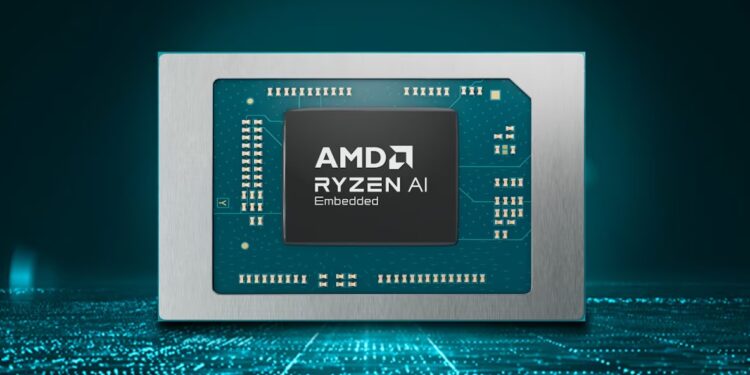
Advanced Micro Devices, Inc. (AMD) today expanded its artificial intelligence silicon portfolio with the launch of the AMD Ryzen™ AI Embedded processors, marking a significant step in the company’s strategy to bring high-performance AI processing to edge-constrained environments. The announcement, issued from AMD’s headquarters in Santa Clara, California, comes as embedded and physical AI applications such as automotive digital cockpits, industrial automation, robotics and autonomous systems increasingly demand real-time, low-latency intelligence on the device.
The new portfolio includes the Ryzen AI Embedded P100 and X100 Series processors. These chips integrate AMD’s “Zen 5” CPU cores, an RDNA™ 3.5 GPU, and a second-generation XDNA™ 2 neural processing unit (NPU) on a compact ball grid array (BGA) package, enabling efficient AI inferencing and graphics compute in power-sensitive settings.
According to AMD’s release, the P100 Series will initially feature configurations with four to six general-purpose CPU cores, significant GPU performance improvements (estimated at roughly 35 per cent faster), and up to 50 trillion operations per second (TOPS) of AI compute capability. The combined architecture is engineered to deliver energy-efficient, responsive performance for immersive applications at the edge.
In a statement included in the release, Salil Raje, senior vice president and general manager of AMD Embedded, emphasized that the new processors are optimized for industries that are pushing immersive AI experiences and smarter autonomous behaviour, all while minimizing system complexity and power consumption.
Target Markets and Applications
The Ryzen AI Embedded portfolio is positioned to serve a range of segments where real-time AI workloads and robust performance are critical:
- Automotive: Enabling next-generation digital cockpits, advanced driver–machine interfaces, voice and gesture recognition, and in-vehicle infotainment systems that respond dynamically to occupants’ needs.
- Industrial Automation: Supporting machine vision, sensor fusion, predictive maintenance, quality inspection and other AI-centric factory floor and robotics use cases.
- Physical AI: Powering autonomous robots and systems that must perceive and respond to changes in real environments with minimal latency and without heavy cloud reliance.
Outlook
Details on availability and specific pricing were not disclosed in the press release, although AMD states that the portfolio is launching “today” as of January 5, 2026. Industry observers will be watching how quickly partners and original equipment manufacturers (OEMs) adopt the new Ryzen AI Embedded processors in products across automotive, robotics, industrial IoT and other sectors.
As AI workloads proliferate across both consumer and enterprise domains, processors such as these are likely to play a key role in shaping the adoption of on-device and edge-centric intelligent systems in the years ahead.