In a funding round that will go down as one of the most significant in technology history, OpenAI has secured approximately $110 billion in new capital commitments from a consortium of major tech investors, led by Amazon, Nvidia, and SoftBank. The announcement, made on Friday, confirms a transformative moment for the AI industry as emerging artificial intelligence platforms seek to scale global infrastructure and commercial deployments.
Below, I set out the verified facts that matter, then unpack operational consequences and market signals that follow from this scale of capital, without hype, and grounded in reporting from major publications.
The Key Points
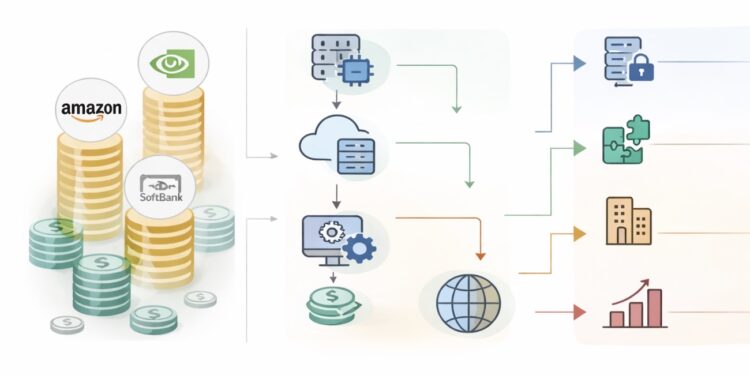
- The reported total capital raise is ~ $110 billion, comprising approximately $50 billion from Amazon, $30 billion from Nvidia, and $30 billion from SoftBank.
- Amazon’s contribution is structured: an initial $15 billion upfront, with $35 billion tied to future milestones or conditions.
- The round has been reported with slightly differing valuation frames: some outlets cite a pre-money valuation near $730 billion, while others report post-money or alternate calculations nearer $840 billion, differences driven by whether outlets treat the infusion as fully priced-in and by timing conventions.
- As part of the tie-ups, AWS is reported to be the exclusive third-party cloud provider for OpenAI’s enterprise platform (“OpenAI Frontier”), and OpenAI has pledged sizable Trainium-based compute capacity on AWS (industry reporting mentions multi-gigawatt commitments).
What each investor brings and why it matters
- Amazon: Beyond capital, Amazon, and specifically Amazon Web Services (AWS), brings wholesale access to datacenters, networking, and a proprietary chip ecosystem (Trainium). Amazon commits significant capital while tying later transfers to measurable outcomes. The AWS exclusivity for the enterprise platform (as reported) creates a commercial corridor that funnels enterprise spend and benchmarks production workloads.
- Nvidia: As the dominant supplier of GPUs and related AI acceleration hardware, Nvidia’s investment is strategic insurance, ensuring that its silicon roadmap remains aligned with OpenAI’s compute needs. Historically, when hardware providers invest down-stack, supply, optimisation, and co-design accelerate; expect tighter collaboration on system architectures and possibly preferential delivery windows for next-generation accelerators. (Bloomberg and Reuters provide reporting on Nvidia’s role and recent renegotiations of earlier, larger commitments.)
- SoftBank: Masayoshi Son’s vehicle has long bet on platform winners with long-duration capital. SoftBank’s cheque signals patience for multi-year capital amortisation on energy, datacenters and talent, the kinds of returns that surface over decades rather than quarters. Its presence emphasises that this is infrastructure-level finance, not a short-cycle consumer play.
Market and competitive
- Higher scale bar for competitors. Smaller, well-funded rivals can still innovate, but competing on raw compute scale and global enterprise deployments now becomes materially harder without similar strategic capital and supplier commitments.
- Consolidation pressure. Expect more strategic investments and tie-ups between chipmakers, hyperscalers and leading AI developers as firms seek guaranteed capacity and data center advantage.
- Valuation variance matters. Divergent reported valuations (Bloomberg’s ~$730B vs. Reuters/others reporting ~$840B frames) matter because they affect dilution, governance and investor expectations for exit strategies such as IPO timing. Analysts will watch which valuation convention OpenAI’s filings ultimately adopt.
Bottom line: a pivot to industrial AI
This funding round converts what has been a software-heavy narrative into an industrial one. OpenAI’s growth will now be measured as much by gigawatts deployed, PPA contracts signed, and datacenter regions live, as by model accuracy or new API features. That is a structural shift, one that brings stability for large customers but also concentrates systemic power with firms that control both capital and compute.