
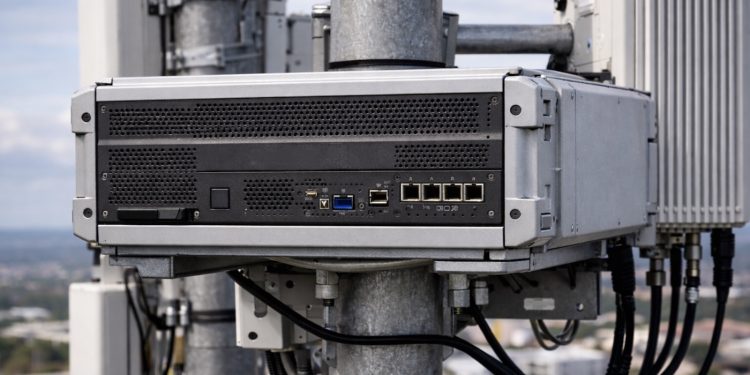
The announcement of the PowerEdge XR9700 by Dell Technologies sharpens a debate in telecom architecture: can purpose-built outdoor edge servers materially change how and where Cloud RAN is deployed? The XR9700 is being billed as a sealed, liquid-cooled x86 server for true outdoor installations, a category that, if realised at scale, would reframe site economics, operational practices and the technical trade-offs of densifying radio networks. This analysis examines the device’s stated capabilities, the engineering compromises it embodies, and the operational implications for Cloud RAN adoption.
At the technical level, the XR9700 ticks three boxes operators have wanted for years in far-edge devices: environmental hardening, compact thermal management, and compatibility with existing orchestration/management toolchains. Dell’s materials indicate IP-rated ingress protection and a closed-loop liquid-cooling system designed to maintain CPU performance in unconditioned outdoor environments. Those features are explicitly aimed at pole-mounted, rooftop or exterior wall deployments where traditional rack, HVAC and real-estate models do not apply. The vendor narrative positions this as a way to run latency-sensitive Cloud RAN functions and local AI inference without routing compute back to centralised sites.
Independent reporting confirms the device is part of a broader industry shift toward bringing compute closer to radio units. Multiple trade outlets note the XR9700’s role in supporting 5G densification and edge AI use cases and place its announcement in the context of operator trials and partnerships. Press coverage also cites the use of recent Intel Xeon designs (Xeon 6 family) that integrate more telco-relevant acceleration into the CPU, reducing the need for discrete accelerator cards in constrained form factors. That silicon choice materially affects how many RAN sectors a single node can realistically serve and how power-efficient real-time processing will be at the far edge.
Those technical facts imply specific, testable expectations for Cloud RAN deployments using outdoor edge servers. First, thermal headroom and power provisioning become central constraints: liquid cooling and sealed enclosures mitigate ambient extremes, but the available sustained power at pole or rooftop mounts will limit peak throughput and the mix of RAN versus AI workloads a node can host. Second, network planners must rethink connectivity redundancy. Moving compute outdoors reduces transport latency but increases reliance on often single-pair backhaul, requiring operators to re-architect link redundancy, site monitoring and remote repair regimes. Third, software maturity for disaggregated RAN (Open RAN / cloud-native vRAN stacks) still varies; hardware that enables outdoor deployments does not alone remove interoperability and orchestration complexity.
Economically, the most immediate impact of deploying outdoor edge servers is a shift in capital and operating cost profiles. Removing the need for cabinets and leased indoor space can lower site acquisition and HVAC opex, but those savings are partially offset by site-specific installation, ruggedised mounting, and more frequent field maintenance cycles. The net ROI is therefore context dependent: dense urban micro-sites with expensive ground leases are the likeliest near-term winners; rural or energy-constrained sites may need additional local power innovations (e.g., high-density batteries, solar) before the model becomes attractive. Several industry writeups and Dell’s own investor materials state the XR9700 will be generally available in the second half of 2026, meaning pilots and operator evaluations should be expected before any broad economic conclusions can be drawn.
Operational risk and security are practical concerns that deserve early attention. Outdoor edge servers introduce new attack surfaces: physical tampering, environmental failures, and localised software compromise. Robust tamper detection, secure boot chains, and hardened remote management must be prescriptive requirements in contracts and deployment playbooks. Moreover, field serviceability, how quickly a tech can swap a failed unit on a pole or rooftop, becomes a determinant of service-level outcomes. Vendors and operators will need to publish and validate real-world mean time to repair (MTTR) data for these environments.
Finally, the strategic value of outdoor edge servers for Cloud RAN is contingent on a systems view: silicon, thermal design, software stack, site economics and ecosystem partners must align. The XR9700 is a reference point, and an operational experiment, rather than a turnkey solution to densification. For network architects, the sensible next steps are deliberate: short, instrumented trials that measure thermal performance, energy per bit for vRAN workloads, failure modes in real climates, and the orchestration overhead of distributed cloud instances. Those empirical data sets will show whether outdoor edge servers move from niche deployments to mainstream elements in Cloud RAN architecture.
Bottom line
Outdoor edge servers like the XR9700 remove several long-standing environmental barriers to placing compute near radios, but they do not eliminate the fundamental operational and economic trade-offs of decentralising network functions. Controlled operator trials, transparent metrics and cautious systems integration will determine whether outdoor edge servers become a standard building block of Cloud RAN or remain a targeted solution for specific densification pockets.