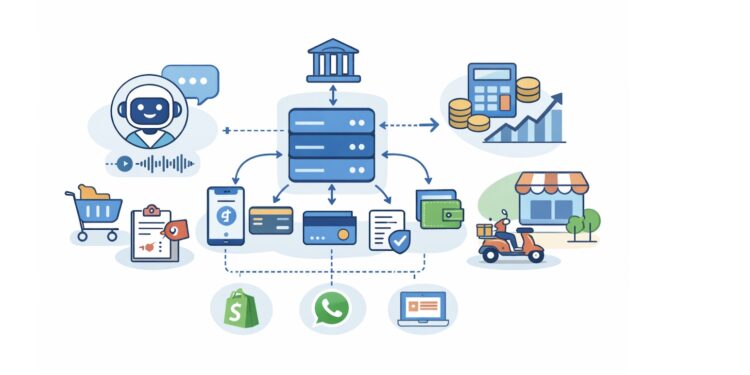
Razorpay has unveiled Agent Studio, an AI-native platform that lets businesses build and deploy autonomous agents to manage payment operations, from abandoned-cart recovery to subscription retries, dispute handling and cash-flow forecasting. The product is presented as a bridge between conversational AI and transactional rails, and was announced as part of Razorpay’s recent AI product slate.
What was announced
- Agent Studio is an AI platform built using Anthropic’s developer tooling; Razorpay says the solution uses the Claude Agent SDK as its agent runtime. The company also described an “agentic experience” layer intended to simplify merchant onboarding and operational workflows.
- Razorpay has framed the offering as both a builder (tools to create custom agents) and a marketplace (prebuilt agents for common payment tasks).
How it works
The public descriptions and product notes indicate three logical layers:
- Conversation/agent layer. Agents run on a conversational LLM agent runtime (Razorpay cites Anthropic’s SDK) so they can interpret intent, hold multi-turn dialogues, and make decisions about next steps (for example, whether to retry a charge or present an alternative payment link).
- Payments orchestration layer. Agents connect to Razorpay’s existing payments stack (UPI, cards, wallets, subscriptions and settlement flows) to execute actions, not merely recommend them. That is, agents can trigger retries, create payment links, and initiate refunds through API calls to the gateway.
- Integrations & data layer. Agent decisions use contextual signals from merchant systems (order history, CRM, catalogue, third-party platforms) to prioritise actions and craft personalised messages. Razorpay emphasises integrations with commerce platforms and messaging channels to enable in-conversation payments.
Use cases and flow examples
- Abandoned-cart recovery: detect an incomplete checkout, generate a contextual message (chat/voice/WhatsApp), present a secure payment link and optionally complete the payment flow inside the conversation.
- Subscription retry & retention: classify failures (card expired, insufficient funds), attempt retries or alternative routes, and automate customer outreach to reduce involuntary churn.
- Dispute and chargeback handling: gather evidence, auto-populate responses to acquirers/networks, and track resolution status, reducing manual casework.
- Cash-flow forecasting: real-time models that combine transaction velocity, refund rates and settlement timing for short-horizon liquidity planning.
These are described as agent actions (execute) rather than only agent suggestions (advise), which is a notable shift in how LLMs are being integrated into mission-critical systems.
Razorpay Agent Studio represents a concrete step toward moving LLMs from advice to action in payments. The technical novelty is less about large language models per se and more about the integration pattern: a conversational agent runtime tightly coupled to high-assurance payment APIs and regulated rails. Early pilots with regulated partners and NPCI are sensible given India’s payment ecosystem, but the practical success of the approach will hinge on consent UX, fraud controls, and predictable economic outcomes (recovery rates, dispute resolution efficiency).
Razorpay’s Agent Studio is a notable industry data point: it codifies a pattern where AI agents become executable operators over payment infrastructure. For technologists, the immediate tasks are to validate security models, define operational guardrails, instrument observability, and measure the real business lift versus added operational risk.