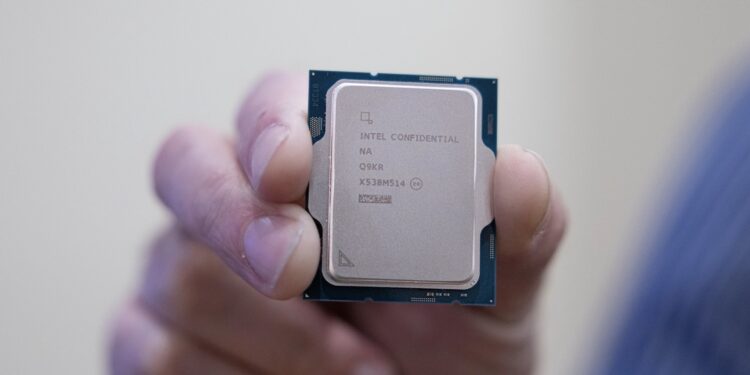
Intel announced a new family of processors, Core Series 2, together with an Edge AI software suite aimed at healthcare and industrial use cases. The company introduced the products on March 9, 2026, at Embedded World.
The Core Series 2 line is presented as a real-time, deterministic platform for edge systems that must run concurrent control and AI workloads on a single node. Intel’s announcement highlights hardware features and time-coordinated compute capabilities intended to reduce worst-case latency and jitter relative to conventional PC processors. In the company’s published benchmarks, Core Series 2 (tested as an Intel Core 9 273PE configuration) shows reductions in maximum PCIe latency and improvements in deterministic response and jitter when compared with an AMD Ryzen 7 9700X in equivalent TDP comparisons. Those comparative figures come from Intel’s release and are reproduced in trade reporting.
Dan Rodriguez, Intel corporate vice president and general manager of the Edge Computing Group, said. “With the introduction of Core Series 2, our CES launch of Core Ultra Series 3, and our expanding Edge AI Suites, we continue to deliver comprehensive platforms that meet diverse edge customer needs with breakthrough performance, reliability, and integrated AI acceleration.”
Alongside the silicon, Intel unveiled an Edge AI Suite for Health & Life Sciences that provides validated reference pipelines and benchmarking scenarios for patient-monitoring applications (ECG arrhythmia detection, remote photoplethysmography and anonymous 3D visual tracking, among them). Intel says the suite is intended to help OEMs, ODMs and ISVs test hardware and software with representative multimodal workloads rather than synthetic tests.
Technical highlights
Independent summaries of Intel’s materials and Intel’s own specification notes list the following platform characteristics:
• Core Series 2 variants with up to 12 performance cores (P-cores) and 24 threads, clocking up to approximately 5.9 GHz in some SKUs.
• Configurations rated at 45 W, 65 W and 125 W; support for up to 192 GB DDR5 with ECC; multiple PCIe Gen5/Gen4 lanes and extended connectivity options for industrial I/O.
• Time-coordinated computing features such as Intel TCC and TSN are intended to improve deterministic timing for control loops.
• Software ecosystem compatibility: OpenVINO, PyTorch, ONNX Runtime and WinML are cited as supported frameworks.
Why this matters for businesses
• Consolidation of workloads: Companies operating factory automation, robotics, or medical monitoring systems prefer fewer, maintainable platforms. A single CPU family that claims deterministic timing plus AI acceleration reduces system complexity and potentially lowers integration costs.
• Procurement and lifecycle considerations: Intel is marketing long-term availability (LTSC) support and industrial configurations, which appeal to sectors that require multi-year product life cycles and supply continuity. Those assurances affect procurement, certification and total cost of ownership.
• Validation and time to market: The Edge AI Suite for Health & Life Sciences supplies reference pipelines and benchmarking that can speed development and regulatory proof points for medical device makers, though clinical validation and regulatory approval remain the responsibility of device manufacturers.
Availability and next steps
Intel states Core Series 2 processors and systems based on them are available now; the Health & Life Sciences Edge AI Suite is available as a preview on GitHub with general availability planned in Q2 2026. Intel’s announcement and the accompanying materials provide benchmark details, configuration notes and legal caveats about performance variability depending on system configuration. Readers evaluating the platform should review the published testing methodology and test on their target hardware and workloads.