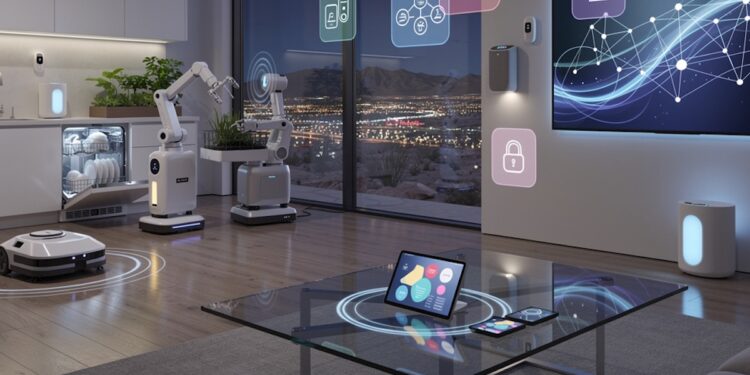
AI has proved its capabilities in consumer electronics, mobility, and smart living products. CES 2026 demonstrated that AI is now seamlessly integrated across multimedia PCs, smartphones, security surveillance, and IoT devices. It operates in the background, becoming an essential part of daily technology.
From Smart Devices to Intelligent Systems
Previously, smart products responded to user commands. Now, products at CES 2026 show that they have the capabilities to anticipate user intent.
Samsung introduced its “Companion to AI Living”. It integrates AI across devices, smartphones, TVs, appliances, and sensors. The platform features AI-enhanced displays, health monitoring, predictive routines, and contextual assistance that anticipates user needs.
TP-Link introduced Aireal, a conversational AI assistant for smart home and networking ecosystems.
Home appliances at the event adapt to user behavior, energy tariffs, and environmental conditions.
This year, devices no longer operate in isolation. AI models, processing locally on dedicated NPUs, connect experiences throughout the home, transforming individual gadgets into integrated systems.
For example, a security camera can inform lighting decisions, and a fitness wearable can influence sleep settings, making the home a responsive environment.
The Rise of On-Device and Edge AI
CES 2026 products show a shift from cloud-based AI to on-device and edge AI processing. In this, the intelligence system runs locally, improving speed, privacy, and reliability. Semiconductor vendors and PC manufacturers emphasized these advancements.
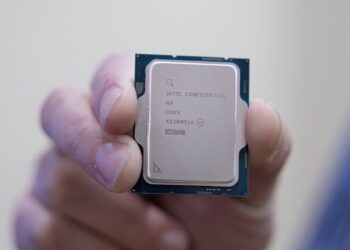
Intel, AMD, and NVIDIA showcased next-generation silicon with dedicated AI processing. Like Intel’s Panther Lake and AMD’s Ryzen AI processors, these feature advanced neural processing units for laptops and PCs that can operate without constant cloud connectivity. NVIDIA’s platforms support high-performance local and hybrid computing across data centers and edge devices.
AI-powered PCs, smartphones, and wearable products now include silicon optimized for real-time inference. It enables live language translation, image generation, and predictive assistance without a constant internet connection.
Automotive products show AI operating directly within vehicles. Cerence AI presented “CaLLM Edge” platforms, which power in-car assistants and vehicle intelligence.
Generative AI Enters the Consumer Mainstream
Generative AI is widely present at CES 2026, but its use was measured. Instead of novelty image generators, consumer products featured AI for creating summaries, automating workflows, on-device video editing, and productivity enhancements.
At CES 2026 in Las Vegas, generative AI transitioned from niche demonstrations to mainstream consumer features embedded in devices and services.
Intel unveiled its Core Ultra Series 3 AI PC platform, which allows on-device generative tasks across productivity and creativity applications without requiring constant cloud connectivity.
Also Read: The Home Router Crisis of 2026: How India’s Living Rooms Became the New Cyberwar Frontline